
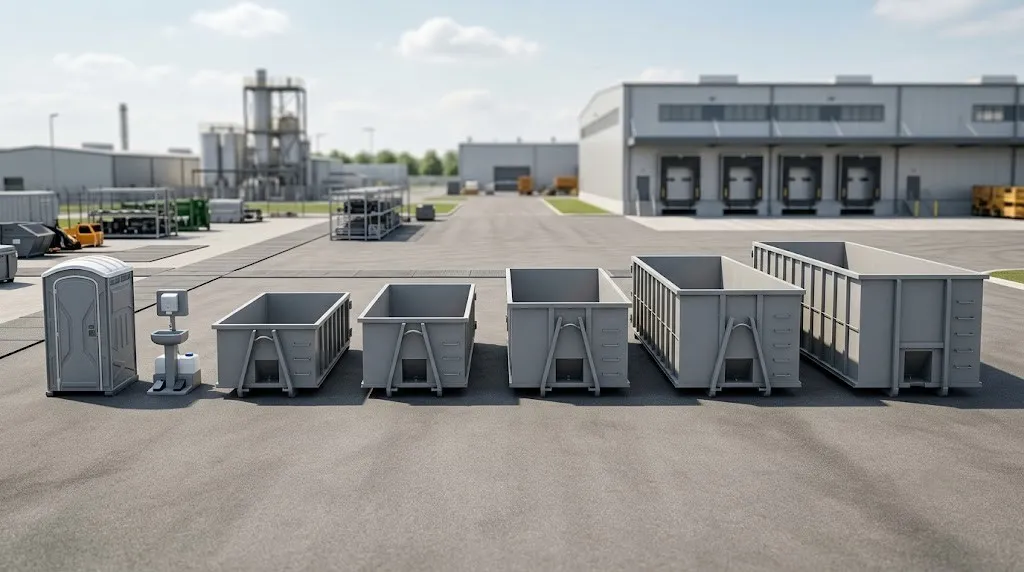
What are the standard roll-off dumpster dimensions?
Container manufacturers such as Wastequip build to a small number of standard footprints, which is why sizes are consistent between haulers. Here are the numbers, with the outside dimensions the driver actually has to work with.
| Size | Length | Width | Wall height | Typical tons included | Pickup loads |
|---|---|---|---|---|---|
| 10 yard | 12 to 14 ft | 8 ft | 3.5 to 4 ft | 1 to 2 | 3 to 4 |
| 20 yard | 22 ft | 8 ft | 4.5 ft | 2 to 3 | 8 to 10 |
| 30 yard | 22 ft | 8 ft | 6 ft | 3 to 4 | 12 to 15 |
| 40 yard | 22 ft | 8 ft | 8 ft | around 4 | 16 to 20 |
Read that table twice. The 20, 30 and 40 yard occupy exactly the same ground. If you have room for a 20 yard, you have room for a 40, and the only question left is whether your debris is light enough to fill the volume before it fills the tonnage. The 10 yard is the only size that buys you a smaller footprint.
What wall height changes about loading
Wall height decides how you load it, not just what it holds. Under about 4.5 feet a person can pitch debris in over the side from ground level. Past that you need a ramp, a walkboard, a chute or a machine.
This is the practical dividing line on a renovation. A 20 yard at 4.5 feet gets loaded by two people carrying buckets out a front door. A 30 yard at 6 feet does not. OSHA 1926.252 requires an enclosed chute whenever material is dropped more than 20 feet to a point outside the exterior walls, and where debris goes through a floor opening without a chute, the landing zone has to be barricaded at not less than 42 inches high and set back at least 6 feet from the projected edge above. On a three story Philadelphia rowhouse that rule bites.
How much space does a dumpster need in Philadelphia?
More than its own length. Budget the container plus roughly 60 feet of straight approach for the truck, and about 23 feet of vertical clearance so the box can tip off the rails without catching a wire, a branch or a fire escape.
Philadelphia's own subdivision street standards set a 26 foot cartway for a tertiary residential street inside a right-of-way of no less than 50 feet. Park cars on both sides of that and the lane left over is barely a truck wide. This is why access, not permits, is the constraint that kills most placements in South Philadelphia, Fishtown, Point Breeze and the Trinity courts behind the main blocks. Suburban lots in Haverford and Abington rarely have the problem at all.
Which dumpster size do you need?
Match the container to the job, then check the block will take it.
| Job | Size | Why |
|---|---|---|
| Single bathroom gut | 10 yard | Fits a rowhouse street, low walls |
| Concrete, brick or soil | 10 yard | Weight fills it before volume does |
| Whole rowhouse renovation | 20 yard | Plaster and lath, still loadable by hand |
| Roof tear-off to 3,000 sq ft | 20 yard | Shingle is dense, volume is moderate |
| Addition or commercial fit-out | 30 yard | Volume job, needs an off-street site |
| Structure demolition, light debris | 40 yard | Cheapest per cubic yard when it fits |
The rule of thumb: if you're between sizes on volume, go up. If you're between sizes on weight, go down. The roll-off dumpster overview compares all four in one place.
Weight limits by container size
The container is not the limit. The truck is. Pennsylvania's Vehicle Code at 75 Pa.C.S. Section 4941 caps gross vehicle weight at 80,000 pounds, and the federal limits at 23 CFR 658.17 add 20,000 pounds on a single axle and 34,000 on a tandem. A roll-off tractor and empty container already account for most of that, which is why a 40 yard can only carry around 4 tons of debris despite holding 40 cubic yards.
Material density is what catches people. Broken concrete runs about 4,000 pounds per cubic yard, soil around 2,200 to 2,700, and old plaster roughly twice the weight of modern drywall by volume. Five cubic yards of concrete is 10 tons, and no truck in Pennsylvania is taking that off a Philadelphia street. Full figures by material are on dumpster weight limits.
Do bigger dumpsters cost more per yard?
No, they cost less per yard and more per rental. Typical Philadelphia weekly ranges reviewed July 2026: $425 to $625 on a 10 yard, $475 to $700 on a 20, $525 to $750 on a 30, and $575 to $775 on a 40. Divide those by volume and the 40 yard is by far the cheapest per cubic yard.
That arithmetic is why people over-order. It only pays if the site can take 22 feet of steel with 8 foot walls, and if the debris is light. Otherwise you have paid more for a container that leaves half empty because it hit tonnage. Every line item is broken out on the dumpster rental cost page.
Does container size change the permit?
Not the paperwork, but it changes whether you get approved. In Philadelphia the Department of Licenses and Inspections issues the dumpster license under Philadelphia Code Section 10-722 and the Streets Department Right-of-Way Unit at (215) 686-5500 issues the placement permit for the street or sidewalk. Section 10-722 lets the Streets Department refuse any location it decides would unduly interfere with the right-of-way.
A 10 yard on a wide residential block clears that test easily. A 40 yard on the same block does not. The Temporary No Parking permit for a dumpster is published at $40 per dumpster for a maximum of seven calendar days, and the 2025 temporary parking prohibition rates were $50 per day for 40 feet of curb in Center City and University City, $25 elsewhere. A longer container means more curb and more days billed. See dumpster permit requirements.
Common questions about dumpster sizes
How big is a 20 yard dumpster in feet?About 22 feet long, 8 feet wide and 4.5 feet tall. Same footprint as the 30 and 40 yard.
How big is a 10 yard dumpster?About 12 to 14 feet long, 8 feet wide and 3.5 to 4 feet tall. Roughly one and a half parking spaces.
Is a 15 yard container a real size?Some fleets carry one, but 10, 20, 30 and 40 are the sizes in general circulation, so plan around those.
How much does an empty container weigh?Roughly 2,000 to 3,000 pounds for a 10 yard, up to 5,500 to 7,500 for a 40, depending on manufacturer and steel gauge. Tare is deducted at the scale.
What can't go in any of them?25 Pa. Code Section 273.201 bars bulk liquids and lead-acid batteries from Pennsylvania municipal waste landfills, and Act 108 of 2010 banned televisions, computers and monitors from municipal waste disposal on January 24, 2013. See what cannot go in a dumpster.
Which size do jobsites usually run?A 30 yard on swaps for volume work, a 20 for renovation. Construction site services covers the rest of the site setup, and OSHA 1926.51(c)(1) requires a toilet where 20 or fewer workers are on site, so a standard unit usually goes on the same order.
What are the 10 yard dumpster measurements?
Roughly 12 to 14 by 8 by 3.5 to 4 feet. Those 10-yard dumpster dimensions suit tight streets.
What are the 20 yard dumpster measurements?
About 22 by 8 by 4.5 feet. Dumpster dimensions 20 yard boxes carry vary by inches between makers.
How many 10 yard dumpster sizes are there?
One. The 10 yard dumpster size is a single container, with slight wall differences by manufacturer.
Send the block, the debris type and a photo through the quote form and we'll tell you which size the street will actually take. Everything we run is on the home page and on porta potty rental in Philadelphia. Coverage is on the service areas page, and the FAQ and contact page cover the rest.
Next step
Get a delivery date
Tell us the address, the dates and the headcount. We size the order and confirm the route.