
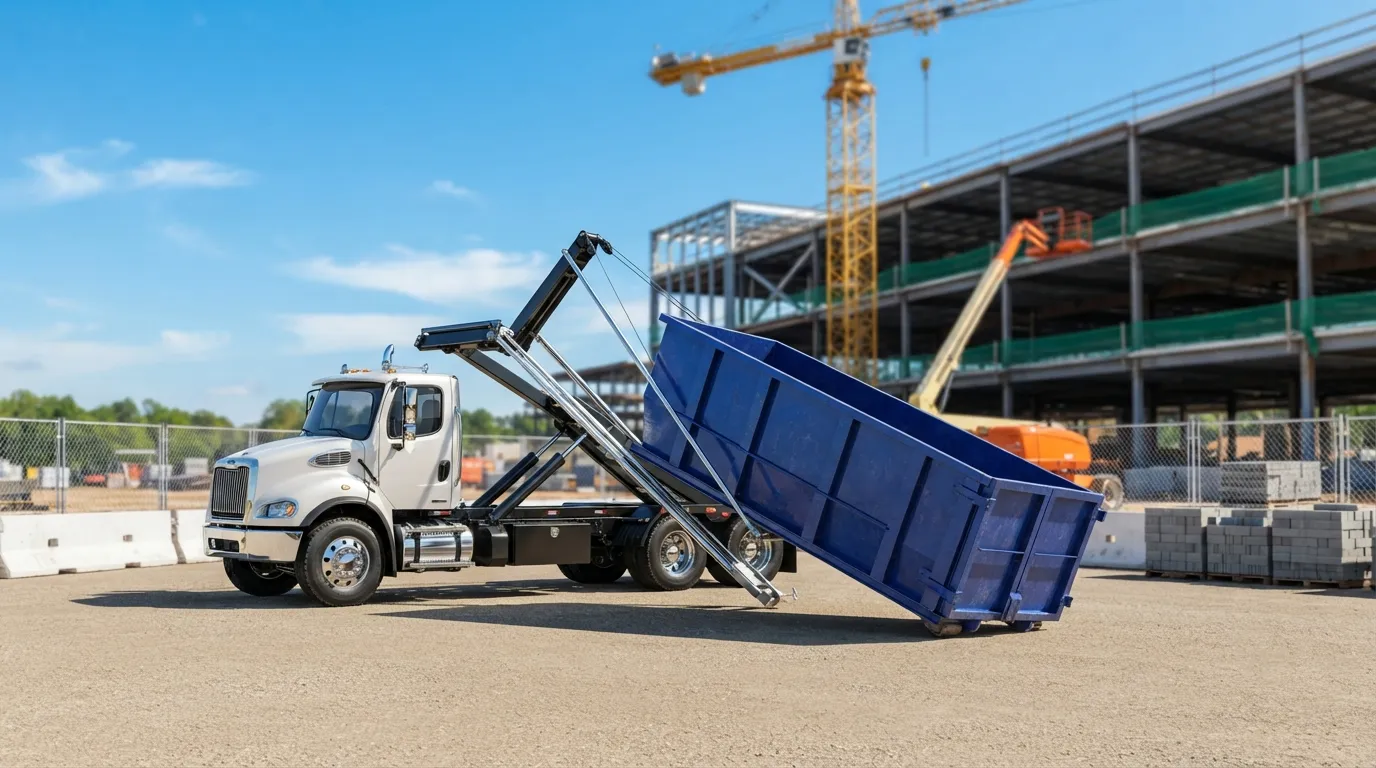
What is a roll-off dumpster?
A roll-off dumpster is an open-top steel container, delivered and collected on a hooklift or cable truck, that rolls off the truck bed on wheels and sits wherever the driver sets it down. Sizes are named for volume in cubic yards. Four are common: 10, 20, 30 and 40 yard.
Manufacturers such as Wastequip build most roll-offs on a 22 foot floor at 8 feet wide, and add volume with wall height rather than length. That means roughly 4.5 foot walls on a 20 yard, 6 feet on a 30 yard, and 8 feet on a 40 yard. The 10 yard is the exception. It is built short, 12 to 14 feet, which is the whole reason it survives on blocks where nothing else fits. Full measurements for every size sit on the dumpster sizes and dimensions page.
Which dumpster size do you need in Philadelphia?
Pick on two axes: how much debris, and how much street you can occupy. In this city the second one usually wins.
- 10 yard. One bathroom gut, a small kitchen tear-out, a basement cleanout, or a heavy clean load of concrete or soil. Takes about one and a half parking spaces.
- 20 yard. The workhorse for a whole-house rowhouse renovation, a roof tear-off, or a full estate cleanout. Low enough at 4.5 feet to load over the side.
- 30 yard. Additions, commercial fit-outs, multi-unit turnovers, and framing waste from new construction.
- 40 yard. Bulky light debris only. Demolition wood, siding, packaging, insulation. Almost never for anything dense.
If you're between two sizes on volume, go up. If you're between two sizes on weight, go down. A container loaded past the fill line can't legally leave the block, and that costs you a wasted trip.
What does a roll-off dumpster cost in Philadelphia?
Typical weekly market ranges by container size, reviewed July 2026. These are market ranges, not a quote for your address.
| Size | Typical week | Usual tonnage included | Extra day |
|---|---|---|---|
| 10 yard | $425 to $625 | 1 to 2 tons | $50 to $95 |
| 20 yard | $475 to $700 | 2 to 3 tons | $55 to $105 |
| 30 yard | $525 to $750 | 3 to 4 tons | $60 to $110 |
| 40 yard | $575 to $775 | 4 tons | $65 to $115 |
What pushes a Philadelphia number up: a permitted curb placement in Center City, a long carry from the truck, a debris stream that has to go to a specialty facility, and anything dense enough to blow the tonnage allowance. What pulls it down: a driveway or lot placement, a clean single-material load, and a longer rental with fewer swaps. The dumpster rental cost breakdown publishes every line separately, including the ones most companies fold into one number.
Weight allowances and what an overage costs
Weekly rentals normally include 1 to 4 tons depending on size, and everything above the allowance bills by the ton at the transfer station rate. Ask for that per-ton figure before you book. A company that won't put it in writing is telling you something.
The ceiling isn't ours, it's the law. Pennsylvania's Vehicle Code at 75 Pa.C.S. Section 4941 caps gross vehicle weight at 80,000 pounds, and the federal limits at 23 CFR 658.17 add 20,000 pounds on a single axle and 34,000 on a tandem. A loaded roll-off truck is already carrying most of that before your debris goes on. Broken concrete runs about 4,000 pounds per cubic yard, so two and a half yards of it is already 5 tons. The arithmetic, by size and by material, is on the dumpster weight limits page.
Do you need a permit for a dumpster in Philadelphia?
On private property, no permit. On the public right-of-way, yes, and Philadelphia runs it differently than most cities. The Department of Licenses and Inspections issues the dumpster license under Philadelphia Code Section 10-722, while the Streets Department Right-of-Way Unit at (215) 686-5500 handles the permit to sit in the street or on the sidewalk.
Two separate things have to be right. The hauler carries a construction dumpster license under Philadelphia Code Section 11-610, priced at $75 per three dumpsters or fraction of three, and every container wears an RFID medallion issued by L&I that transmits the license number and the licensee's phone number. Then the placement itself needs a Temporary No Parking permit from the Streets Department, published at $40 per dumpster for up to seven calendar days. The dumpster permit requirements page walks the whole sequence, including what the plot plan has to show.
Why access matters more than permits on a Philadelphia block
Philadelphia's own subdivision street standards set a 26 foot cartway for a tertiary residential street inside a right-of-way of no less than 50 feet. Take two parked cars off that and you're down to a lane. A 22 foot container on a hooklift truck wants roughly 60 feet of straight approach and about 23 feet of overhead clearance to tip the can off the rails.
That's why plenty of South Philly, Fishtown and Point Breeze jobs end up on a 10 yard container even when the debris volume says 20. Trinity houses and the alley courts behind them are worse again. Send a photo of the block before you book. Two minutes on a phone saves a dry run, and the driver would rather know now. Tight-site notes are covered in the placement guide and the pre-delivery checklist. Suburban lots in Abington, Lower Merion and Doylestown rarely have this problem at all.
What cannot go in the container
Pennsylvania restricts more material than people expect. 25 Pa. Code Section 273.201 bars bulk liquids from municipal waste landfills, along with any container holding free liquids larger than a gallon, and lead-acid batteries. The Covered Device Recycling Act, Act 108 of 2010, has banned televisions, desktops, laptops, monitors and computer peripherals from disposal with municipal waste since January 24, 2013.
Federal rules add more. Refrigerators and window air conditioners need certified refrigerant recovery under Section 608 of the Clean Air Act before the unit can be scrapped. Fluorescent tubes, mercury devices and most batteries fall under the Universal Waste Rule at 40 CFR Part 273. Anything meeting an ignitability, corrosivity, reactivity or toxicity characteristic under 40 CFR Part 261 is hazardous waste and needs its own manifest. The complete list, with where each item actually goes in this city, is on what cannot go in a dumpster.
Roll-off dumpsters for construction and demolition
Demolition is the volume driver. EPA's national accounting put construction and demolition debris at roughly 600 million tons generated in 2018, more than twice the municipal solid waste stream, with over 90 percent of it coming from demolition rather than new build.
On a jobsite the container is a safety fixture, not just a bin. OSHA 1926.252 requires an enclosed chute whenever material is dropped more than 20 feet to a point outside the exterior walls, and where debris goes through a floor opening without a chute, the landing area has to be barricaded at not less than 42 inches high and set back at least 6 feet from the projected edge above. Scheduling swaps around that is its own skill. See construction dumpster rental for phase-by-phase sizing, and construction site services if the crew also needs restrooms, fence and a job box. Most university and hospital sites in West Philadelphia end up running a 30 yard on a swap schedule alongside chain link fence and a temporary power pole.
Rowhouse renovation and residential cleanouts
Rowhouse renovation is the steadiest dumpster demand in Philadelphia, and it produces a debris mix nothing else does: plaster and lath, joist ends, old knob-and-tube, cast iron, and a century of layered flooring. Plaster runs roughly twice the weight of drywall per cubic yard, which is why a 20 yard on a full gut often hits its tonnage before it hits the fill line.
Residents do have a free option for small volumes. The city runs six Sanitation Convenience Centers, open Monday through Saturday from 8 a.m. to 6 p.m., but you have to show proof of Philadelphia residency, the vehicle has to weigh under 6,000 pounds total, and commercial loads get turned away. For anything past a car boot, a container is the honest answer. Long interior jobs usually want a renovation restroom on site too, and a monthly porta potty is cheaper than weekly billing past about three weeks.
What our drivers need before the truck rolls
- A clear approach of about 60 feet, with no branches or wires under 23 feet
- Cars moved off the drop spot, and Temporary No Parking signs posted the day before on a street placement
- Plywood down if it lands on a driveway or new concrete, which we bring
- A named contact who is actually reachable on the day
- The debris type stated up front, because a clean concrete or dirt load is priced and hauled differently
- Gate widths and any weight-restricted alley flagged at booking
How long can you keep a dumpster?
A standard rental period is 7 to 14 days, and extra days run $50 to $115 each. Philadelphia's Temporary No Parking permit for a dumpster is published for a maximum of seven calendar days, so a street placement that runs longer needs the permit renewed, not just the rental extended.
On the right-of-way the meter matters. The Streets Department's temporary parking prohibition rates were published in 2025 at $50 per day for 40 feet of curb in Center City and University City, and $25 per day everywhere else in the city. Across a six week renovation that adds up, which is one argument for putting the can on private ground even when the carry is longer. Short jobs sometimes work out better on a day rate footing for the sanitation side and a single swap on the container.
What a fair dumpster quote includes
Delivery, pickup, the rental period, the tonnage allowance and disposal should all sit inside the quoted number. Broken out separately and stated plainly, you should also see the per-ton overage rate, the per-day extension rate, any permit cost passed through at cost, and any surcharge for a specialty stream such as mattresses, tires or appliances.
What should never appear as a surprise: a fuel charge invented after the fact, an environmental fee with no definition, or a trip charge for a dry run that happened because nobody mentioned the block. If a line on your invoice has no explanation, ask. Our pricing page exists so you can check ours against the market before you call.
Questions people ask about roll-off rental in Philadelphia
Can a dumpster sit on my driveway?Yes, with plywood under the rails. That's a thirty second conversation at booking and it prevents an argument about a cracked apron later.
How fast can you deliver?Next business day is normal for private property across the city and out to King of Prussia, Upper Darby and Camden. Street placements move at the permit's pace. Coverage is listed on the service areas page.
Do I have to be there for delivery?No, as long as the spot is clear and marked. Most customers leave a cone or a chalk line.
Can I put a mattress in it?Usually yes, with a per-item charge, because mattresses are pulled for separate processing at most transfer stations. Estate and hoarding cleanouts that produce a lot of them are worth quoting through the cost page first.
Is a 40 yard cheaper per cubic yard?Yes, but only if the site can take it. The 40 yard page has the arithmetic, and a 20 yard beats it on almost every rowhouse block.
Does the load need to be covered?Ours is, on the road. Federal cargo rules at 49 CFR 393.100 require that nothing leaks, spills, blows or falls from the vehicle, so the driver tarps before pulling off.
Do you handle asbestos?No. Philadelphia's Air Management Services Asbestos Control Unit regulates that work under Philadelphia Code Sections 6-606 and 6-607, and the federal asbestos NESHAP at 40 CFR Part 61 Subpart M requires notification 10 working days ahead of a demolition. It goes to a licensed abatement contractor, never into a can.
Does my business need a waste plan too?If you operate regulated premises, yes. Philadelphia Code Sections 10-717 and 10-724 require a written Solid Waste and Recycling Plan naming each hauler you use.
What if the job also needs restrooms?Most do. OSHA 1926.51(c)(1) requires one toilet on a site with 20 or fewer workers, and the OSHA restroom requirements guide and porta potty rental cost cover the rest. A standard unit plus a handwashing station is the usual pairing, with an ADA unit where the site is open to the public. Crew counts are worked out on the sizing calculator, and the sink rules are on handwashing requirements.
What does dumpster rental roll off actually mean?
The container rolls off the truck bed on rails. That is the whole name.
Which size do most Philadelphia jobs take?
A 20 yard dumpster rental covers most renovations, so a 20 yard roll-off dumpster rental is our default quote.
Is a 10 yard roll off dumpster enough for concrete?
Usually yes. Heavy clean loads go small, because the truck has a legal lift limit.
Is roll off dumpster rental near me next day?
Often, on private property. Street placement waits on the permit, not on us.
Still choosing? Start with sizes and dimensions, then check what a container can legally weigh if the load is heavy. Jobsite crews should read construction dumpster rental and the permit rules. Everything we run in the city is listed on the home page and on porta potty rental in Philadelphia. Send the address and the debris type through the quote form, call the number on the contact page, or read who we are. The FAQ covers the rest, and temporary fencing, storage containers, light towers and a mobile office trailer drop on the same run. Nearby crews book from Conshohocken and Norristown as well.
Next step
Get a delivery date
Tell us the address, the dates and the headcount. We size the order and confirm the route.