
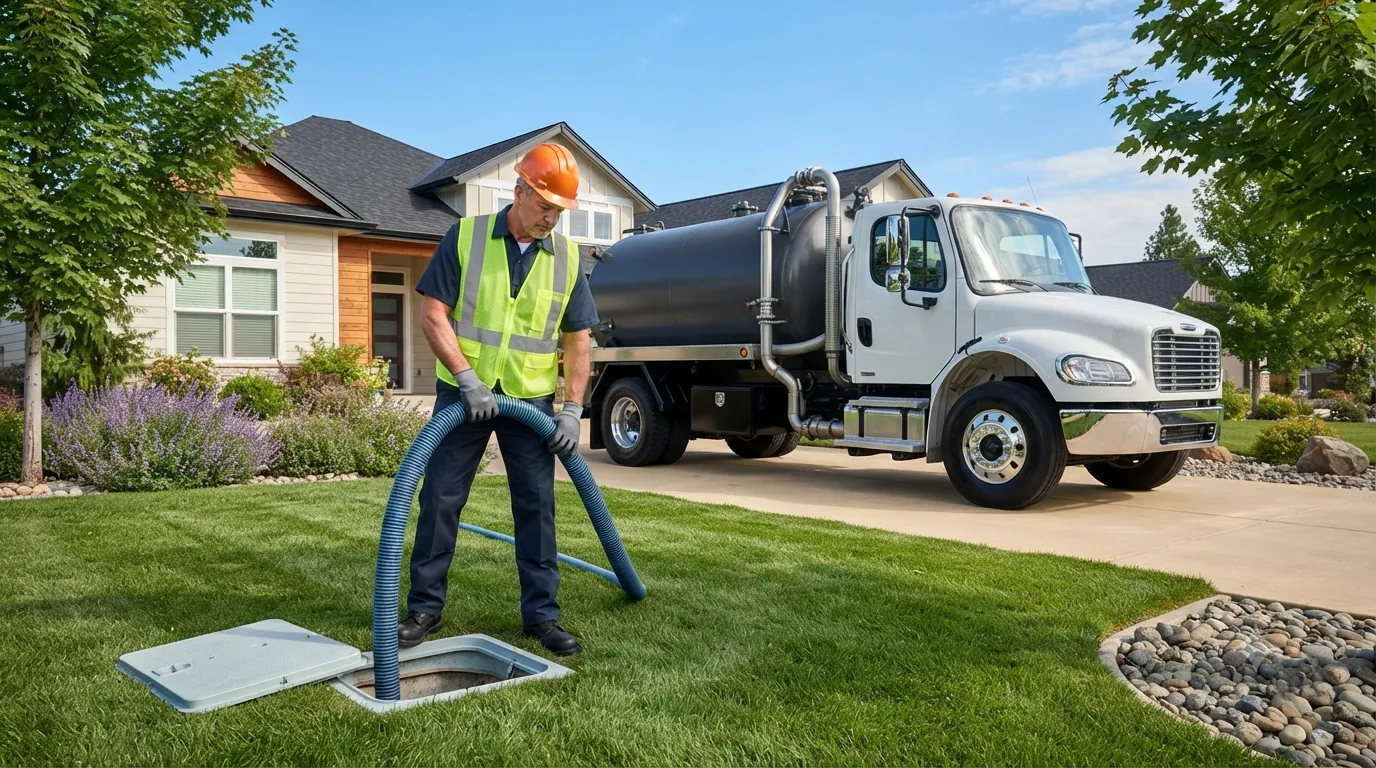
Is septic tank cleaning the same as pumping?
Almost. Pumping is the vacuum removal of the liquid and the sludge. Cleaning is that plus the part that gets skipped: breaking up and removing the compacted layer on the floor of the tank, and rinsing the walls and baffles so what is left behind is not a head start on the next four years of buildup.
The distinction matters because a tank can be emptied and still be dirty. Sludge at the bottom compacts into a dense mat that a suction hose will pass straight over if nobody backflushes it. A crew in a hurry drops the hose, pulls the liquid, and leaves. The tank reads empty on a dipstick and fills with solids again in eighteen months.
What a proper clean out covers:
- Both compartments emptied, not just the inlet side
- Backflushing to lift and suspend the settled sludge before final suction
- Washing down the interior walls and the underside of the lids
- The effluent filter pulled, rinsed and refitted
- Inlet and outlet baffles checked for the cracking that lets scum escape to the field
- The lids reseated and the access resealed
The full service description sits on septic pumping service, which is the pillar page for everything below.
How often does a septic tank need cleaning?
Every three to five years for a typical household, per the US EPA SepticSmart guidance, with the real interval set by tank volume against how many people use it. Penn State Extension publishes the frequency table the region works from, and it puts a 1,000 gallon tank serving four people at about 2.6 years and the same tank serving two people at about 5.9.
| Household | 1,000 gallon tank | 1,500 gallon tank |
|---|---|---|
| 2 people | 5.9 years | 9.1 years |
| 3 people | 3.7 years | 5.9 years |
| 4 people | 2.6 years | 4.2 years |
| 6 people | 1.5 years | 2.6 years |
A garbage disposal, a heavy laundry load or a house that switched from two occupants to five pulls those figures down hard. The reasoning behind the table, and the adjustments that actually apply, are on how often a septic tank needs pumping.
Cleaning the septic tank filter
An effluent filter is a cartridge in the outlet tee that catches suspended solids before they reach the drainfield, and it is the cheapest component in the system protecting the most expensive one. Replacing a failed drainfield is a different order of expense from rinsing a filter.
Filters clog on their own schedule, not the tank's. A house with a new baby, a new dishwasher or a septic tank that has not been touched in six years can blind a filter in months. The symptom is a slow drain across the whole house with no other sign of trouble, and it is often mistaken for a blockage in the line.
Rinse it back into the tank, never onto the ground. Not every tank has one. Systems permitted before effluent filters became standard practice frequently do not, and a clean out is the moment to ask whether fitting one makes sense on your outlet tee.

What does septic tank cleaning cost?
Typical market ranges, reviewed July 2026. Ranges, not a quote.
| Job | Typical range |
|---|---|
| Residential clean out to 1,000 gallons | $150 to $300 |
| Tank of 1,250 to 1,500 gallons | top of the band or above |
| After hours or emergency | call out premium on top |
| Excavating a buried lid before work starts | added labour, quoted on site |
| Grease interceptor | by interceptor size, disposal costs more |
Water weighs 8.34 pounds per gallon, so a full 1,000 gallon tank holds more than 8,300 pounds, and the haul to a permitted receiving facility is a real line in the price rather than a markup. Distance from the tank to where the truck can stand is the other driver. The itemised version is on septic tank pumping cost, and rental equipment is priced the same way on porta potty rental cost.
What condition is the tank in when we open it?
Neglected tanks tell you what happened. Scum crusted to four or five inches across the surface means years without service. A liquid level above the outlet invert means the drainfield is not accepting flow, and pumping will buy weeks rather than fix anything. Steel tanks, common in mid-century installations, corrode from the top down, and a lid that flexes underfoot is a safety problem before it is a plumbing one.
None of that is something we can tell you over the phone, and none of it is a reason to skip the clean out. It is a reason to be there when the lids come off. Signs you can read from the house are covered on septic tank warning signs.
Getting the truck to the tank in this region
Access is the constraint that decides whether a clean out happens on the day. A vacuum truck typically carries 100 to 200 feet of 3 inch suction hose. Past that reach the truck has to come closer, because the hose will not stretch further.
On the narrow rowhouse blocks through South Philadelphia, Fishtown, Kensington and West Philadelphia, one car parked across the approach is enough to end the visit, and most city properties have a holding tank rather than a septic tank anyway. Out in the townships the problem inverts: the drive is long, the lot is big, and the tank is 90 feet behind the house under a lawn nobody has opened in a decade.
Where we cover for septic work:
- Doylestown, 26.2 miles out in Bucks County
- Bensalem, 14.8 miles northeast
- Norristown at 18.8 miles and King of Prussia at 17.3
- Abington at 8.6 and Conshohocken at 13.5
- Chester at 22.6 and Haverford at 11.9
- Lower Merion, Upper Darby, Camden and Cherry Hill
The whole ring is listed on service areas.
Who regulates a septic tank in Pennsylvania?
Onlot systems fall under the Pennsylvania Sewage Facilities Act, Act 537 of 1966, which makes each municipality responsible for planning sewage facilities and puts permitting with a local sewage enforcement officer rather than a single state desk. Design and construction standards come from 25 Pa. Code Chapter 73, the Department of Environmental Protection rules for onlot sewage treatment facilities.
Routine cleaning needs no permit. Altering, repairing or replacing a tank does, and the permit comes from your township or borough. Inside Philadelphia the picture is different again: the portable toilet and holding tank application runs through the Department of Public Health under its infectious waste program, not through a streets department, which routinely catches contractors out. See permit requirements.
Questions about septic tank cleaning
Do additives replace a clean out?No. The EPA is direct on this in its SepticSmart material. Nothing poured down a drain removes inorganic solids from the floor of a tank.
Should the tank be refilled with water afterwards?It refills on its own with normal household use. A concrete tank sitting empty in saturated ground can float, which is one more reason not to leave it standing empty for long.
Can you clean a tank in winter?Yes, though a frozen lid and frozen ground add time. Freeze and thaw is also when riser lids and shallow lines fail, which is the busiest window for emergency septic calls.
Do you clean holding tanks?Yes, and inside the city that is usually what is actually in the ground. See holding tank rental and service.
Do you cover restaurants?Yes, through grease trap pumping, which is a separate waste stream with its own disposal route.
Book a clean out
Is cleaning septic tank contents the same as pumping?
Pumping empties. Septic tank cleaning service work scrapes the walls and the outlet baffle too.
Do you handle cleaning septic tank filter work?
Yes. The effluent filter clogs long before the tank fills, and it is a five minute job.
How often septic tank cleaning is needed?
On the same 3 to 5 year interval as pumping, sooner with a garbage disposal.
Is septic tank cleaning near me priced per gallon?
Cost septic tank cleaning is quoted per tank here. Septic tank cleaning price rises with access difficulty.
Tell us the address, roughly when the tank was last emptied, the size if you know it and where a truck can park. Request a quote or contact us. You may also want what pumping costs, the warning signs, our service areas, the FAQ or the home page.
Next step
Get a delivery date
Tell us the address, the dates and the headcount. We size the order and confirm the route.