
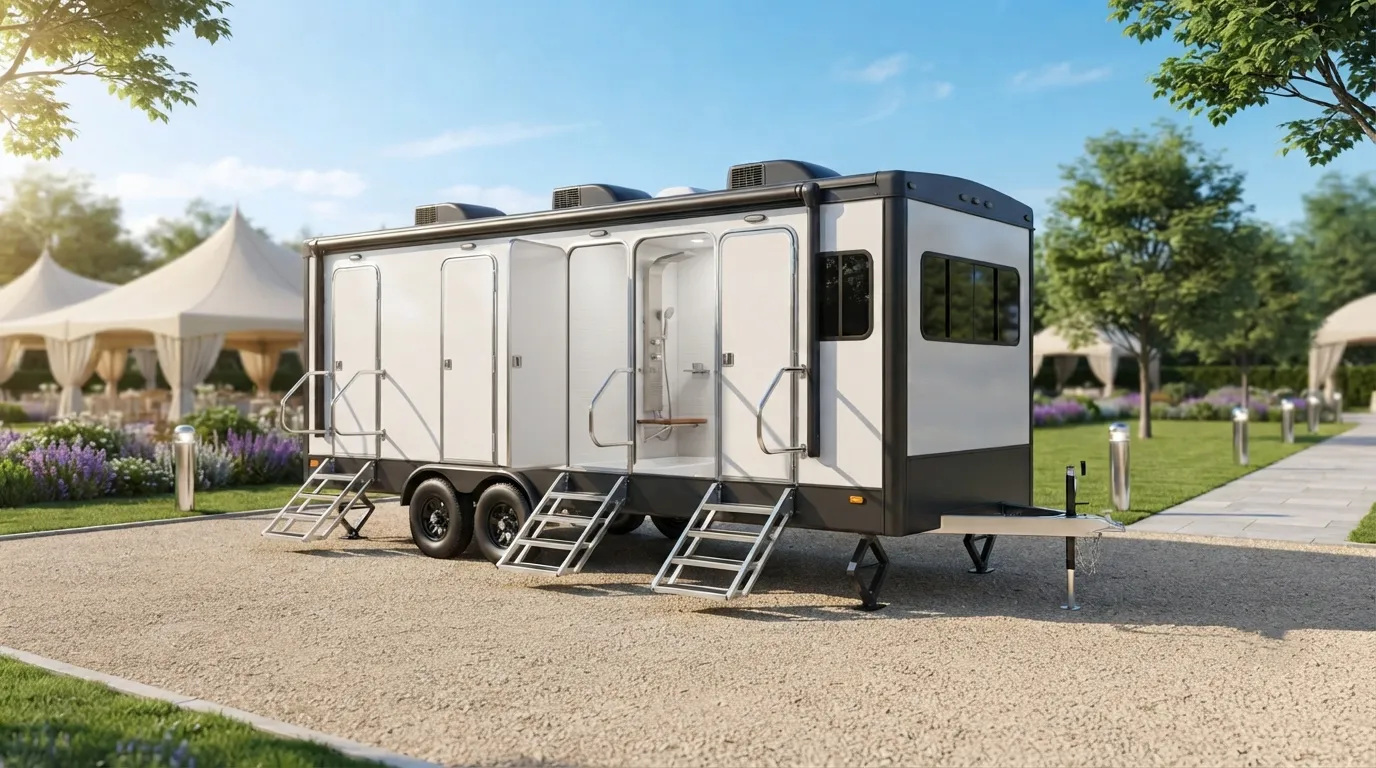
What is a shower trailer?
A shower trailer is a towable unit containing private shower rooms with hot running water, a water heater, a fresh water tank and a waste tank, used where people need to wash and there is no plumbed bathroom available. Most units include a bench, a hook, a small changing area and a lockable door in each stall.
It is not the same product as a restroom trailer, though the chassis and the tank arrangement look alike. A restroom trailer is built for throughput over a few hours. A shower trailer is built for hot water volume and drainage, and it lives on sites that run for weeks. Some builds combine the two, which is covered further down this page.
Shower trailer sizes and specifications
Typical manufacturer specification ranges for towable shower trailers by stall count:
| Stalls | Body length | Fresh water | Waste tank | Water heater | Power |
|---|---|---|---|---|---|
| 2 | 14 to 16 ft | 100 to 200 gal | 200 to 300 gal | 20 to 40 gal | 30 amp |
| 4 | 16 to 20 ft | 200 to 300 gal | 400 to 650 gal | 40 to 80 gal | 30 to 50 amp |
| 6 to 8 | 24 to 32 ft | 300 to 500 gal | 800 to 1,250 gal | 80 gal or on demand | 50 amp or generator |
Most trailers plumb directly to a garden hose rather than running off the onboard tank, because tank capacity disappears fast. At the federal maximum of 2.5 gallons per minute set by the Energy Policy Act of 1992, a single eight-minute shower uses about 20 gallons. EPA WaterSense labelled showerheads cut that to 2.0 gallons per minute, which is what most rental fleets fit, and it stretches a 200 gallon tank from roughly ten showers to twelve.
What does a shower trailer cost in Philadelphia?
| Unit | Per day | Weekend | Per week | Per month |
|---|---|---|---|---|
| 2 stall shower | $300 to $650 | $900 to $1,700 | $1,200 to $2,200 | $2,400 to $4,500 |
| 4 stall shower | $500 to $950 | $1,400 to $2,400 | $1,800 to $3,200 | $3,600 to $6,000 |
| Combination shower and restroom | $400 to $800 | $1,100 to $2,000 | $1,500 to $2,800 | $3,000 to $5,200 |
Market ranges reviewed July 2026, not a quote. Delivery in a weekly context typically adds $50 to $150 and each service visit $30 to $220, and on a shower trailer the service interval is usually shorter because the waste tank fills faster than a restroom unit's. The full breakdown sits on restroom trailer rental cost, and porta potty rental cost covers the standard fleet.
Who rents shower trailers in Philadelphia?
Five situations account for most shower trailer calls in this city, and only one of them is an event.
- Storm and flood response. When the Schuylkill or the Delaware comes up and homes lose service, shower trailers go in alongside the rest of the disaster relief sanitation package.
- Rowhouse whole-house renovations. A gut job takes the only bathroom out of service for weeks, and a shower trailer on the sidewalk or in the rear court keeps the owners in the house. That pairs with home renovation porta potty rental.
- Long-duration construction. University City hospital and campus builds run crews for months, and OSHA 1910.141(d)(3)(i) requires one shower for every 10 employees of each sex who have to shower on the same shift. See construction site services.
- Film and television production. Base camps on Center City blocks need washing facilities for cast and crew, covered on film set restroom rental.
- Multi-day sport and outdoor events. Rowing regattas on the Schuylkill, road races and staging in the Sports Complex lots near Lincoln Financial Field and Citizens Bank Park all pull shower units, usually next to marathon and road race restrooms or festival restrooms.
Building plumbing outages are the sixth, and they are seasonal. A frozen or failed riser in a university residence or an older apartment building puts hundreds of people without a shower overnight, and the fix is a trailer in the parking lot until the plumbing is back.
How much water and power does a shower trailer need?
A shower trailer needs a continuous water supply, a drain or waste tank, and considerably more electrical capacity than a restroom trailer because of the water heater. Two-stall units generally run on a 30 amp service, and larger units on 50 amps or a generator.
NFPA 70, the National Electrical Code, rates a 120 volt, 20 amp branch circuit at roughly 2,400 watts, which is nowhere near enough for an electric water heater plus pumps. Article 590.6 requires GFCI protection on temporary receptacles, and around water that requirement is not a formality. Where the site has no adequate supply, a temporary power pole or a generator is part of the plan, and light tower rental covers the walk to the trailer after dark.
On the water side, a 5/8 inch garden hose at typical municipal pressure refills the fresh tank at a useful rate, so most Philadelphia jobs run continuously fed rather than tank-only. Waste is the constraint that catches people out: every gallon in becomes a gallon out, and at 8.34 pounds per gallon a full 650 gallon grey water tank weighs over 5,400 pounds. That is why a shower trailer gets pumped on a schedule the way a holding tank or a septic tank does.
Combination shower and restroom trailers
A combination trailer puts shower stalls and flushing toilets in one body, usually two showers and two restrooms on a mid-size chassis. It is the right choice when the site needs both and there is only room for one unit, which describes most Philadelphia rowhouse blocks and tight jobsites.
The trade-off is capacity. Splitting a fixed tank between showers and toilets means shorter intervals between services on both. Where space allows, a separate 4 station restroom trailer alongside a dedicated shower unit works better, and on smaller sites a 2 station restroom trailer plus a two-stall shower does the same job. Higher-finish shower builds for weddings and hospitality sit on luxury restroom trailers.
Access, permits and Philadelphia blocks
Getting a shower trailer onto a Philadelphia street is the same problem as any trailer here, and it is usually harder than the paperwork. Narrow one-way blocks parked on both sides leave no clear approach, and a driver who arrives to find a car in the drop spot cannot set the unit. Hold the space, and tell us which direction the truck should come from.
The permit routing is genuinely unusual. Philadelphia issues portable toilet and holding tank approvals through the Department of Public Health under its infectious waste program, not through a streets or transportation department, so allow review time rather than expecting a counter transaction. Private property placements sit outside that process entirely. Detail on porta potty permit requirements and approach notes on the placement guide.
Accessibility, service and winter operation
Accessible shower provision is a separate build. The 2010 ADA Standards set a minimum 30 inch by 60 inch roll-in shower compartment in section 608.2.2, with a 36 inch clear route to the door under section 403.5.1, and standard trailer stalls do not meet that. Where an accessible shower is needed we specify it up front rather than adapting one on site. ADA restroom requirements covers the equivalent rules for toilets.
Service on a shower trailer means pumping grey water, refilling fresh water, restocking soap and paper, checking the heater and cleaning the stalls. ANSI/PSAI Z4.3, the American National Standard for nonsewered waste-disposal systems, sets weekly service as the baseline, and heavy-use jobsites run twice-weekly or better. See how often units are cleaned. Below freezing the unit has to run heat continuously and the supply hose needs heat tape, because a shower trailer has far more exposed water line than a restroom unit. Porta potties in winter covers the wider cold weather picture.
How do you book a shower trailer in Philadelphia?
Tell us four things and the quote comes back accurate: how many people will shower and over what hours, how long the unit is needed, what power is available at the pad, and whether there is a hose bib and a place for the vacuum truck to reach the outlet.
Can I rent shower trailer units by the week?
Yes. Portable shower trailer rental runs weekly or monthly, with a service schedule attached.
Use the quote form or call through the contact page. If it is an emergency, say so, because emergency porta potty rental and emergency septic service run on a different response track. Handwashing is usually ordered at the same time, either as a portable sink, a handwashing station or a hand sanitizer stand, and the requirements are set out on handwashing requirements. We deliver across the city and out to Norristown, Chester, Upper Darby and the rest of the areas we serve around Philadelphia. More on how we work is on the about page and the FAQ.
Next step
Get a delivery date
Tell us the address, the dates and the headcount. We size the order and confirm the route.