
What does a construction site services package include?
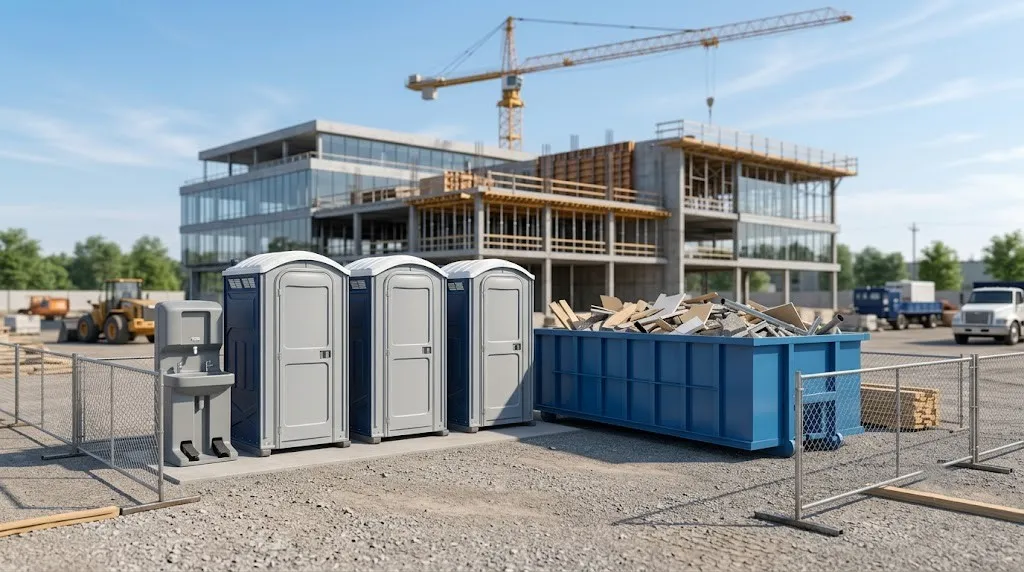
A construction site services package is a bundle of temporary equipment delivered to one jobsite on one schedule, so the site has toilets, waste disposal, washing and containment without four separate vendors turning up on four different mornings.
On a typical Philadelphia job that means:
- One or more standard units, sized to the crew under OSHA 1926.51(c)(1)
- Weekly servicing, which pumps the tank, restocks paper and washes the interior
- A handwashing station or a portable sink
- A roll off dumpster sized to the demolition volume
- Temporary fencing where the site opens onto a footway
- A storage container for tools that cannot go home in a van
Longer or larger jobs add a mobile office trailer, a light tower for winter afternoons, and a temporary power pole before the utility drop lands.
How many porta potties does an OSHA jobsite need?
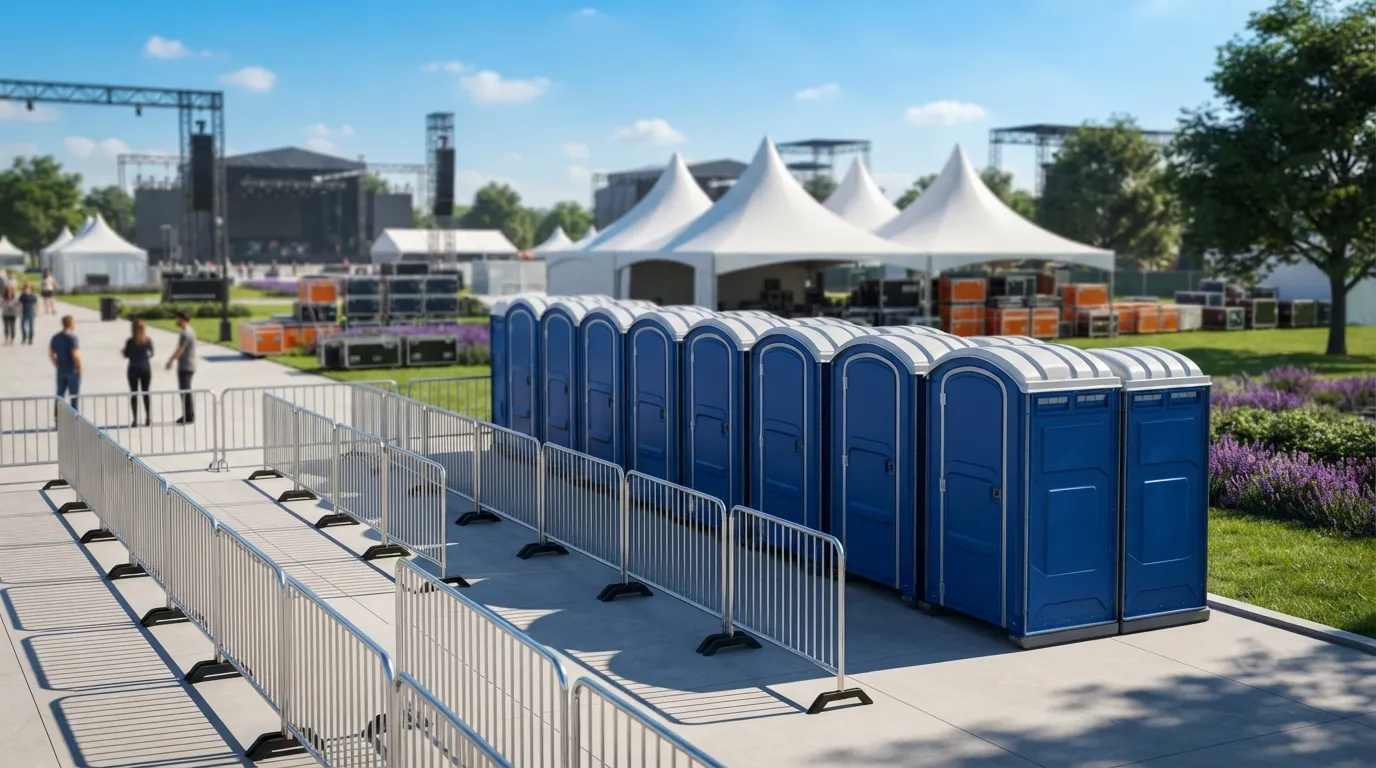
OSHA 1926.51(c)(1) sets the count for construction. One toilet covers 20 or fewer workers. From 20 to 200 workers you need one toilet seat and one urinal per 40 workers. Above 200 it becomes one toilet seat and one urinal per 50 workers.
| Workers on site | Toilet seats | Urinals |
|---|---|---|
| 1 to 20 | 1 | 0 |
| 21 to 40 | 1 | 1 |
| 41 to 80 | 2 | 2 |
| 81 to 120 | 3 | 3 |
| 121 to 160 | 4 | 4 |
Two Philadelphia adjustments to that table. Rowhouse gut jobs run a peak crew far above the daily average, so size to the framing or drywall week rather than to the trim week. And OSHA 1926.51(c)(4) lets mobile crews use transportation to nearby toilets instead, which sounds convenient right up until a roofing crew in Kensington spends 25 minutes a head walking to a corner store. The OSHA requirements page works through the exemptions, and the unit calculator handles mixed crews.
Construction site services pricing in Philadelphia
Typical market ranges, reviewed July 2026. Ranges, not a quote, because the drive and the access decide as much as the equipment does.
| Item | Typical range | Basis |
|---|---|---|
| Standard unit | $125 to $325 | per month |
| Standard unit | $130 to $500 | per week |
| ADA unit | $250 to $500 | per month |
| Handwash station | $100 to $175 | per month |
| 20 yard dumpster | $426 to $778 | per week |
| Dumpster day extension | $51 to $112 | per day |
| Storage container | $100 to $250 | per month |
| Temporary fence | $30 to $75 | per day |
| Delivery | $50 to $150 | per movement |
| Weekly service | $30 to $60 | per unit |
Monthly is where jobsites belong. A unit taken by the week costs roughly what a month costs once you pass three weeks, which is the entire reason the monthly rate exists. Full breakdowns sit on what porta potty rental costs and dumpster pricing.
The rowhouse problem, which is the real Philadelphia constraint
Permits are not what stops deliveries here. Parked cars are. Across South Philadelphia, Point Breeze, Fishtown, Grays Ferry and much of West Philadelphia the street is a one-way rowhouse block, cars both sides, no setback at all. A standard cabin measures roughly 44 by 48 inches on the common manufacturer models and stands about 90 inches tall, so the unit fits almost anywhere. The service truck is what does not, and it needs a clear approach plus room to work.
What we ask before a first delivery:
- Which side of the block the truck can stop on, and whether it is a street cleaning day
- Whether the unit lands in the rear yard, on the footway, or inside the site fence
- Whether there is a shared driveway or a rear alley the neighbours also use
- Overhead wires and tree canopy on the approach
- Whether the block is under an active utility cut
Give us that on the first call and the delivery lands once. Miss it and the truck comes back, which nobody enjoys paying for. The placement guide lists the clearances we work to, and service areas covers what changes past the city line.
University and hospital construction
West Philadelphia and University City carry a steady load of institutional construction, and those clients write site rules that go past the OSHA minimum. Expect accessible units to be required rather than optional. Expect a written servicing schedule. Expect the sanitation setup to be looked at alongside everything else on the site walk.
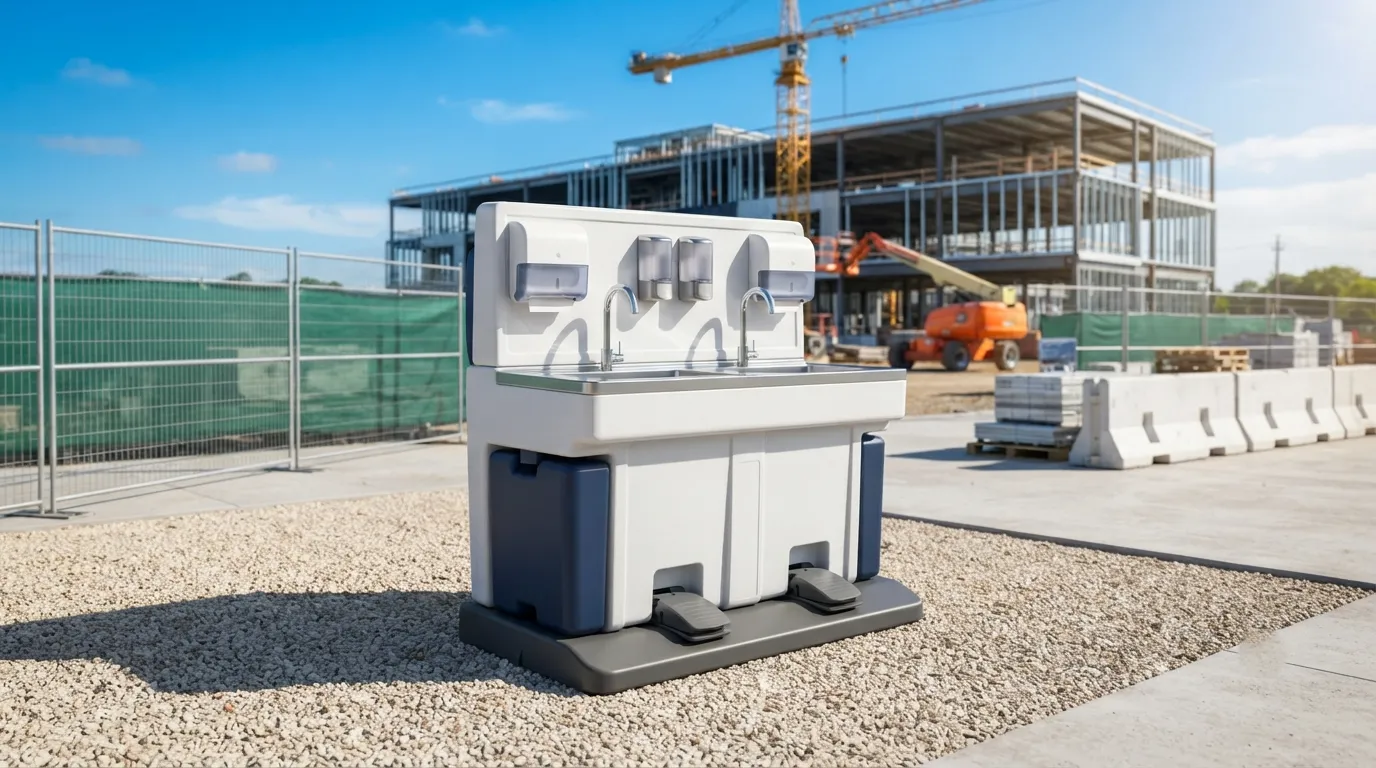
That pushes three things onto the order. An ADA unit at each cluster, since the 2010 ADA Standards at section 213.2 Exception 4 require 5 percent of clustered single-user units, and never fewer than one, to comply with section 603. A washing setup that meets OSHA 1926.51(f)(1) rather than a bottle of gel on an upturned bucket. And enclosed placement, because a unit left on an open campus footway gets used by the whole neighbourhood.
What does ANSI/PSAI Z4.3 say about servicing?
ANSI/PSAI Z4.3, the industry standard for non-sewered waste disposal systems, puts the baseline at one service visit per week for a unit carrying roughly 10 users a day across a 40-hour week. That is the number to plan against.
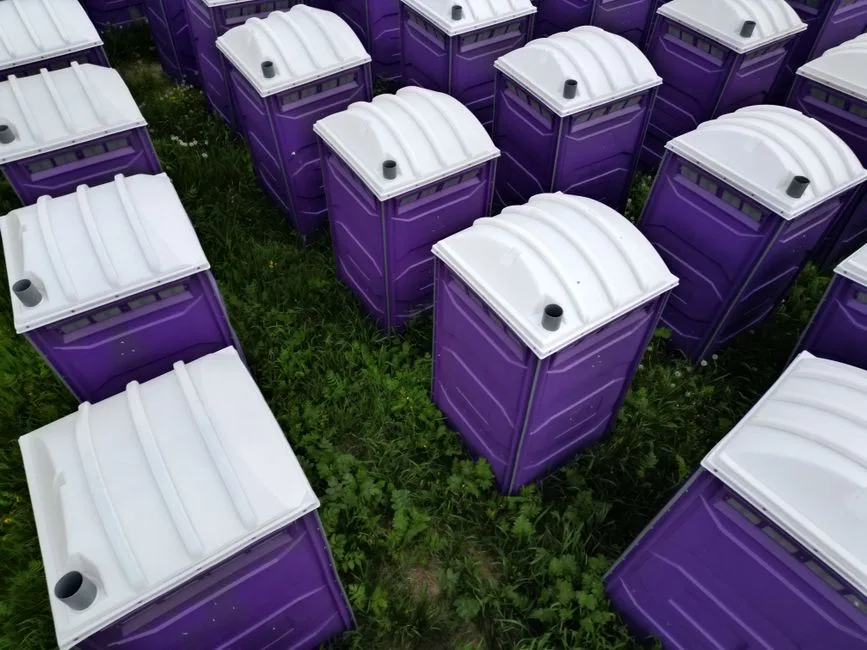
Above that ratio the interval shortens. One unit serving 20 workers through a summer framing week needs twice-weekly service or it fails on a Thursday, and the failure is smell before it is capacity, because the tank on a standard cabin holds only 60 to 70 gallons. Winter runs the other way and weekly holds fine. More on how often units are cleaned and whether they smell.
Do I need a permit for a jobsite porta potty in Philadelphia?
Only if the unit sits on public ground. Inside the site fence or in a rear yard, no permit applies. On the footway, in the parking lane, or on any city right of way, you need one.
Philadelphia routes it unusually. The application covering portable toilets and holding tanks is issued by the City of Philadelphia Department of Public Health under its infectious waste program, rather than by a streets or transportation department. Contractors who have worked in other cities reliably look in the wrong place first and lose a week doing it. Start from the permit requirements page, and check dumpster permits separately, because a container in the parking lane is a different application again.
Winter work
Philadelphia winters are cold enough to freeze a tank and mild enough that nobody plans for it. Standard practice is a winter additive in the tank, a service interval that does not slip, and a placement that gets afternoon sun rather than sitting all day in the shadow of a party wall. Doors freeze shut on units left unserviced through a hard week. See porta potty in winter for what changes between December and March.
Questions Philadelphia contractors ask
Can you deliver to a site with no street parking at all?Usually yes, if we know first. On the tightest Fishtown and Point Breeze blocks we schedule the drop for early morning, before the block fills up.
How fast can you get a unit out?Same day or next day on standard units across most of the city. Genuine emergencies go through emergency porta potty rental.
Do you swap the dumpster and service the units on one visit?Where the schedule allows, yes. That saves a delivery charge and one truck movement on a narrow block.
What size dumpster suits a rowhouse gut?Most full-floor gut jobs land on a 20 yard container. Kitchen and bath work usually fits a 10 yard. Plaster and masonry hit the weight limits long before they fill the box.
Do you handle holding tanks for trailers on site?Yes. Holding tank rental and septic pumping run off the same trucks.
Do you cover the suburbs?Across the ring, including Conshohocken at 13.5 miles and Norristown at 18.8.
Set up a site package
What does construction portable toilet rental include?
Delivery, a weekly service and pickup. Portable toilet rental for construction sites is billed monthly here.
What is portable toilet rental for construction sites cost on a small crew?
One unit covers up to 10 workers a week under OSHA 1926.51(c). Price follows unit count, not headcount.
Tell us the crew size, the length of the job and the block. We size it to OSHA rather than to the invoice. Request a quote or contact us. Related: construction dumpster rental, porta potty rental in Philadelphia, standard units, the FAQ, about us, or the home page.
Next step
Get a delivery date
Tell us the address, the dates and the headcount. We size the order and confirm the route.