
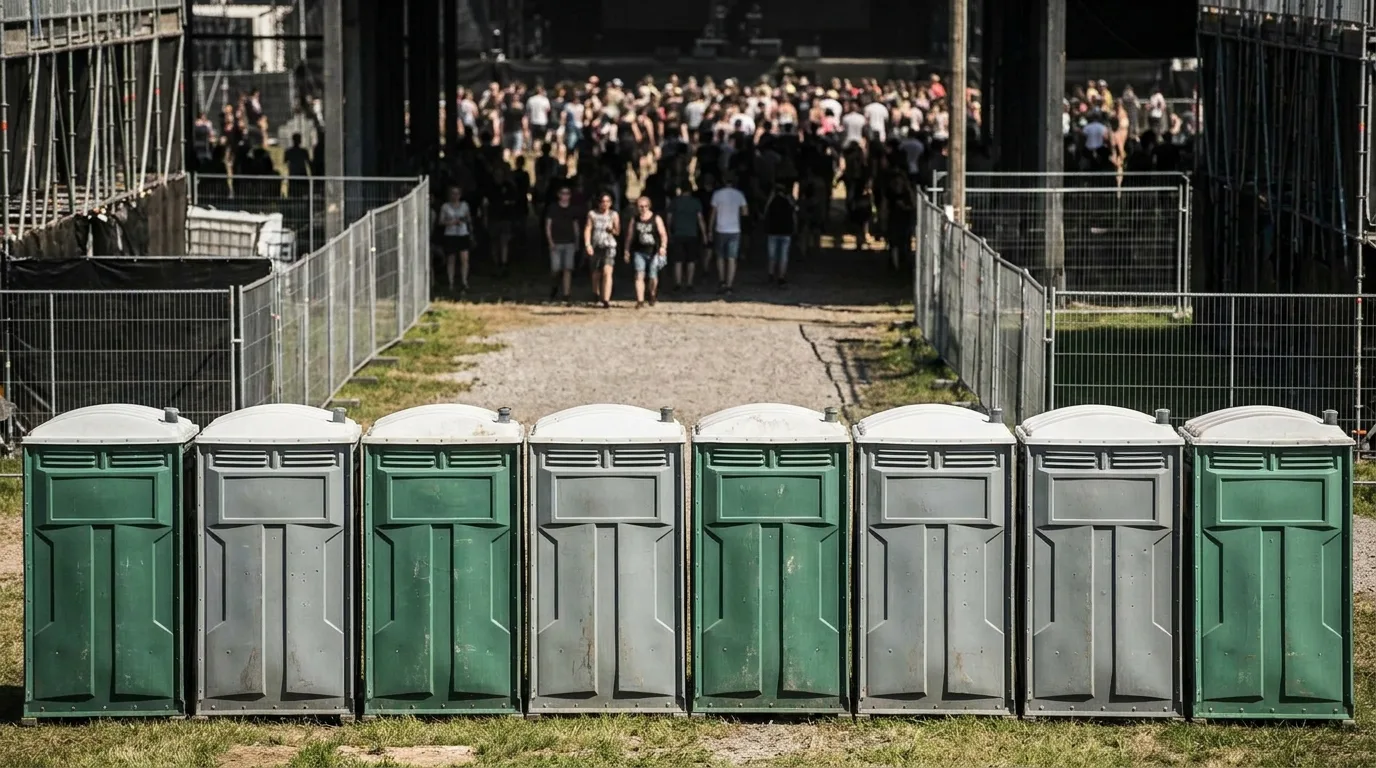
Those two ratios cover most of the calls we take. The rest of this page is the detail that moves them: duration, alcohol, accessible proportions, food service, and the thing that catches Philadelphia orders more often than any regulation, which is whether the truck can physically reach the spot you picked.
How many porta potties do I need for a construction site?
One toilet for 20 or fewer workers. Above that the ratio steps down, and OSHA 1926.51(c)(1) publishes it as a table rather than a formula:
| Workers on site | Minimum under OSHA 1926.51(c)(1) |
|---|---|
| 20 or fewer | 1 toilet |
| 20 or more | 1 toilet seat and 1 urinal per 40 workers |
| 200 or more | 1 toilet seat and 1 urinal per 50 workers |
Pennsylvania runs no state OSHA plan covering private employers, so the federal standard applies directly on Philadelphia construction sites with nothing layered on top of it. Treat the ratio as a floor. Two shifts, a crew split across four floors of a hospital fit-out in University City, or a site where the nearest alternative is a coffee shop three blocks away all argue for going above it.
What that looks like on the jobs we actually deliver to:
- 6 to 20 workers, one standard unit on a monthly cycle
- 21 to 40 workers, 2 units, and a second weekly service once the weather turns warm
- 41 to 80 workers, 3 to 4 units, split between the site trailer and the far end of the work
- 100 or more workers on a university or hospital build, 5 or 6 units with a handwashing station at each cluster
Jobs running past about six weeks price better as a monthly porta potty rental than by the week. The construction site package covers what usually ships alongside.
How many porta potties do I need for an event?
One unit per 50 guests for a four hour event, then more as the hours stack up. Portable sanitation industry sizing charts have used that ratio for decades and it holds, because usage tracks duration at least as closely as it tracks headcount.
| Guests | 4 hours | 6 hours | 8 hours |
|---|---|---|---|
| 50 | 1 | 1 | 2 |
| 100 | 2 | 3 | 3 |
| 250 | 4 | 5 | 6 |
| 500 | 6 | 8 | 9 |
| 1,000 | 12 | 15 | 17 |
| 2,000 | 22 | 26 | 30 |
Those counts assume no alcohol and a roughly even split of men and women. Manufacturer specs put a standard unit's holding tank at 60 to 70 gallons, which works out near 175 to 200 uses before the tank becomes the limit rather than the queue. That is why the eight hour column is higher than the four hour column for the same crowd. Same people, twice the volume in the tank.
Event work here clusters around a handful of places and each sizes differently. Start at event restroom rental, or the pages for festivals, concerts, races, weddings and golf tournaments.
Does alcohol change the count?
Yes, by more than most people budget for. Add 15 to 20 percent to the unit count when alcohol is served. Guests go more often and they stay longer once they are in there. On a 500 person event that is one extra unit at the low end and two at the high end.
Tailgating in the sports complex lots at the south end of Broad Street is the clearest local case. Lincoln Financial Field, Citizens Bank Park and the Wells Fargo Center all have plumbing inside, so the portable units exist for the parking lots, where the crowd arrives hours before the gates open. Size those on the tailgate window, not on the kickoff time.
Beer gardens and street festivals behave the same way. If the licence covers the whole run of the event, use 20 percent rather than 15.
How many accessible units do I need?
Five percent of each cluster, and never fewer than one. The 2010 ADA Standards for Accessible Design, at section 213.2 Exception 4, provide that where single user portable toilet units are clustered at a single location, 5 percent of the units in each cluster, and at least one, must comply with section 603.
Per cluster is the phrase that costs people money. A road race with units at five points along the route needs a compliant unit at all five, not one at the finish. A 40 unit festival split into four banks of ten needs four accessible units, not two.
| Units in the cluster | Accessible units required |
|---|---|
| 1 to 20 | 1 |
| 21 to 40 | 2 |
| 41 to 60 | 3 |
| 61 to 80 | 4 |
The ADA unit page carries dimensions and pricing, and ADA restroom requirements covers the route, the ground surface and the signage that has to go with them.
Do I need handwashing stations too?
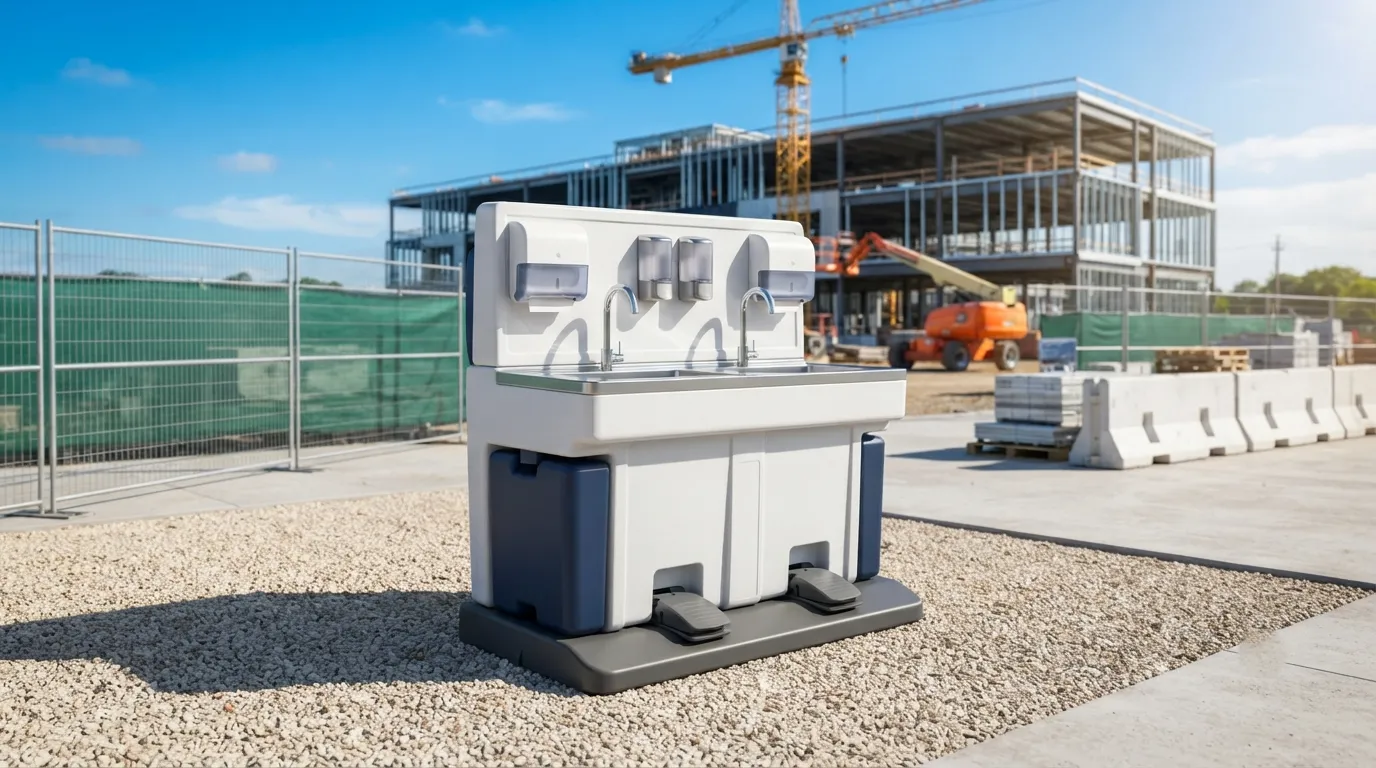
On a jobsite, yes. OSHA 1926.51(f)(1) requires washing facilities where employees are engaged in the application of paints, coatings, herbicides or insecticides, or in other operations where contaminants may be harmful. Most general contractors in Philadelphia treat a wash station as standard kit rather than reading that exemption narrowly, and inspectors respond well to it.
Ratios that work in practice:
- One portable sink per two toilet units on a jobsite
- One wash station per four units at a general event
- One per unit where food is served, which is most of the Penn's Landing calendar
- Hand sanitizer stands as a supplement, never as the only provision
Handwashing requirements goes through what the standard actually asks for, including the water temperature question.
Sizing a Philadelphia block party
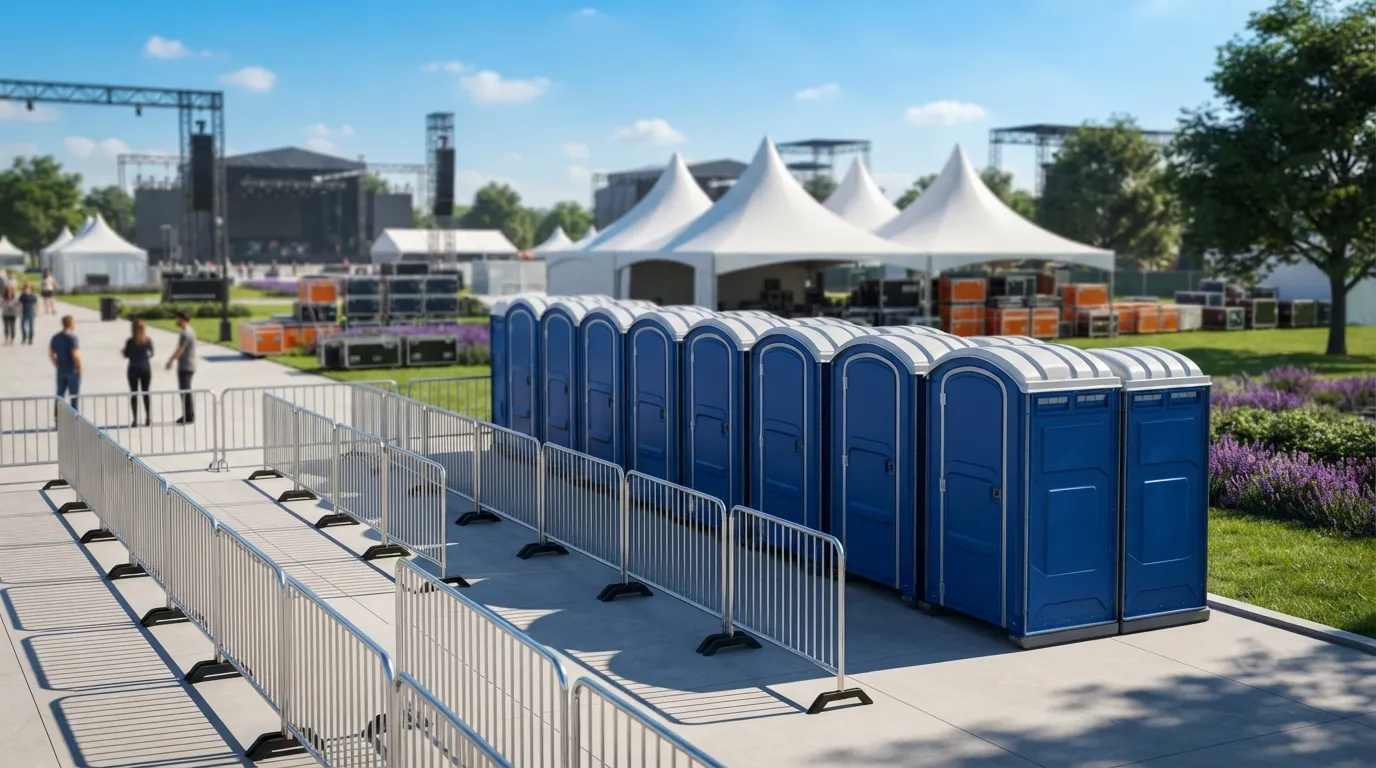
Block parties are the most common small order in this city and the easiest to get wrong in both directions. A typical closed rowhouse block runs 30 to 60 houses, and the crowd on the street peaks in the late afternoon instead of spreading evenly across the day.
One unit covers a block party of up to about 100 people over four or five hours. Two is right once the count passes 150, or once a caterer or a bar is involved. Nobody needs six.
The real constraint is where the unit goes, not how many you order. Philadelphia's street standards set a 26 foot cartway on a tertiary residential street, and with cars parked both sides what is left is barely a truck wide. The unit lands in what was somebody's parking space, and the driver needs a clear approach to set it down. Flag one space the night before. The placement guide covers clearance, and permit requirements covers the paperwork, which in this city routes through the Department of Public Health rather than a streets office.
Sizing for Fairmount Park and Penn's Landing
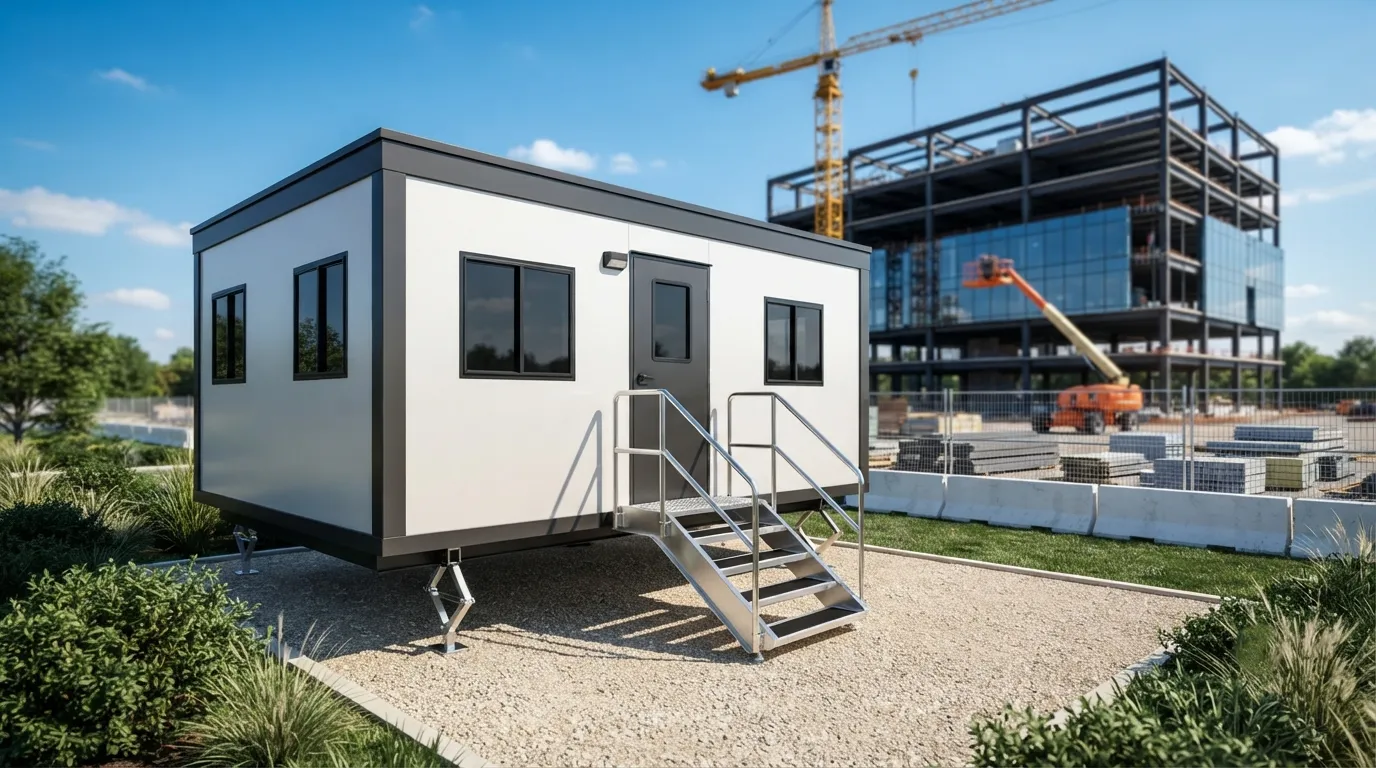
Park and waterfront events break the simple ratio because of walking distance. Fairmount Park is big enough that one bank of units at a single entrance leaves part of your crowd walking eight to ten minutes each way, and people who face that walk stop going, which becomes a different problem.
Split the order. Two banks of four beat one bank of eight for the same money, and they halve the queue at peak. At Penn's Landing the issue changes: the ground is a mix of hard surface and event lawn, the lawn goes soft after rain, and the units end up on the paved edge where the service truck can also reach them.
One more local quirk. Trolley routes, one way blocks and the loading restrictions through Old City mean the truck's route in sometimes decides the placement, which in turn caps how many units fit in one spot. Give us the address early and that conversation happens once instead of on delivery morning.
When a trailer replaces a bank of units
A restroom trailer is a towable unit with flushing toilets, running water and climate control, used where standard portable toilets would feel inadequate. One trailer replaces a bank of standard units on comfort rather than on raw capacity. Two stalls handle roughly what three or four standard units handle at a slower paced event.
Trailers need a level pad, a tow route and power. Manufacturer specs on a two stall commonly call for a dedicated 20 amp 110 volt circuit and around 100 gallons of onboard freshwater. Compare 2 stall, 4 stall and 8 stall layouts, or the luxury option, then check trailer pricing against the same money in standard units.
How many yards of dumpster does the same job need?
The other half of the "how many" question on most jobsites is the container. Volume in cubic feet is fixed by the yardage, and the tonnage allowance is set by what a truck can legally carry rather than by the box.
| Size | Cubic feet | Typical tons included | Floor size |
|---|---|---|---|
| 10 yard | 270 | 1 to 2 | 12 to 14 ft by 8 ft |
| 20 yard | 540 | 2 to 3 | 22 ft by 8 ft |
| 30 yard | 810 | 3 to 4 | 22 ft by 8 ft |
| 40 yard | 1,080 | around 4 | 22 ft by 8 ft |
Pennsylvania's Vehicle Code at 75 Pa.C.S. Section 4941 caps gross vehicle weight at 80,000 pounds, which is why a 40 yard box still only carries about 4 tons of debris. Full detail sits on dumpster sizes and dimensions, weight limits by material and the roll-off overview. For a rowhouse gut, the 10 yard and the 20 yard are the two that fit a narrow block; the 30 and 40 need off-street room.
Three worked counts
A 250 guest wedding at a Fairmount Park venue, 6 hours, alcohol served. Base count 5, add 20 percent for alcohol to reach 6, and one of those has to be accessible. Most couples put a 4 stall trailer on the guest side and two standard units on the vendor side. Price it against the cost breakdown.
A 45 worker rowhouse rehab in Point Breeze, 5 months. OSHA 1926.51(c)(1) puts the floor at 2 toilet seats and a urinal. Order 2 standard units and a wash station, weekly service, monthly billing, plus a construction dumpster.
A 1,200 person one day street festival, 8 hours, beer garden. Base 17, plus 20 percent for alcohol, lands near 20 units. Split it into three banks, one accessible unit minimum per bank, four wash stations and a mid event service visit. That is a festival order, not a delivery.
What goes wrong if you order too few?
Queues first, then the tank. Once a unit passes roughly 175 to 200 uses it needs service whether the event is finished or not, and a unit that fills at hour six of an eight hour event is out of action for the two hours that matter most.
Under ordering also breaks the accessible count, because the 5 percent rule in section 213.2 Exception 4 of the 2010 ADA Standards is calculated per cluster. Shrink the clusters and the compliant unit is often the one that gets cut. That version of the mistake has consequences well past a queue.
If you end up short mid event, emergency porta potty rental exists, and it costs more than getting the count right the first time.
Get the count checked before you book
How many cubic feet in a 10 yard dumpster?
About 270. How many feet is a 10 yard dumpster on the ground? Roughly 12 to 14.
How many cubic feet in a 20 yard dumpster?
About 540. How many feet is a 20 yard dumpster? Around 22 long by 8 wide.
Send the headcount, the hours, whether alcohol and food are involved, and the address. We will give you a count and tell you plainly if we think you are over ordering. Request a quote or get in touch. Related reading: porta potty rental in Philadelphia, how often units get serviced, the OSHA rules in full, the booking checklist, winter jobsite units, areas we cover, the FAQ, about us and the home page.
Next step
Get a delivery date
Tell us the address, the dates and the headcount. We size the order and confirm the route.