
What is temporary fence rental?
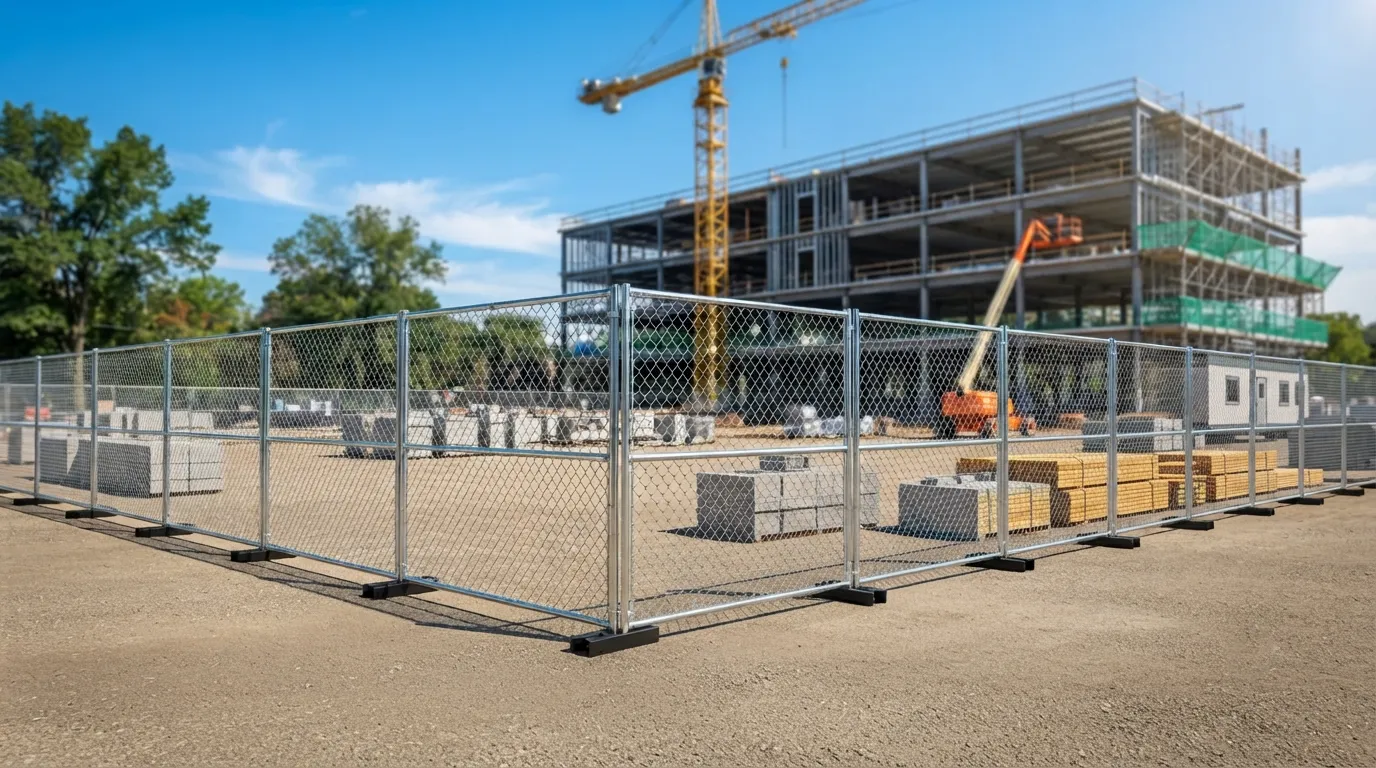
Temporary fence rental is a run of freestanding chain link panels, held upright in weighted bases and joined by couplers, that encloses a site without anything being dug into the ground. It comes on a truck, goes up in a morning and leaves when the job does.
The system is deliberately simple, and that is its strength. Three parts:
- The panel, chain link fabric in a tubular steel frame
- The base, a weighted block the panel foot drops into
- The coupler, a clamp that joins two panels at the top rail and stops the line hinging
Nothing is driven into the ground, so nothing hits a utility, and nothing needs making good afterwards. On a city site where the ground is a mixture of old cellar, brick fill and unrecorded services, that matters more than it does anywhere else. For panel detail see chain link temporary fence, and for crowd lines rather than site perimeter see crowd control barrier rental.
Panel sizes and specification
| Panel | Size | Approx weight | Best for |
|---|---|---|---|
| Standard | 6 ft high x 12 ft wide | 40 to 45 lb | Site perimeter, most jobs |
| Short bay | 6 ft high x 10 ft wide | Slightly less | Tight frontages, corners |
| Tall panel | 8 ft high x 12 ft wide | Heavier | Where code or the client calls for 8 ft |
| Pedestrian gate | 6 ft, single leaf | Panel weight plus hinge | Foot access |
| Vehicle gate | Two leaves, 12 to 20 ft opening | Panel weight per leaf | Deliveries and plant |
Frames are made from tubular steel around 1 and 3/8 inches outside diameter, with chain link fabric in the
11.5 to 12.5 gauge range and a 2 inch mesh. Zinc coating on chain link fabric is covered by ASTM A392 and the framework by ASTM F1043, which is why a panel that has been outside for five winters still looks like a fence rather than a rust stain.
A single person can carry a panel. Two people should. At 40 to 45 pounds and 72 square feet of area, a panel carried alone on a windy day at Penn's Landing becomes a sail with a person attached.
How many fence panels do I need?
Divide the perimeter by 12 and round up, then add a panel for each gate opening. Then walk the line, because the arithmetic never survives contact with a real site.
| Perimeter to enclose | Standard panels | Bases |
|---|---|---|
| 60 ft | 5 | 6 |
| 100 ft | 9 | 10 |
| 200 ft | 17 | 18 |
| 400 ft | 34 | 35 |
| 1,000 ft | 84 | 85 |
You always need one more base than panel, because each end of the run needs a foot. Corners eat length, gates interrupt the count, and a run that has to step around a stoop or a street tree will use more panels than the tape says.
Send a sketch or a screenshot of the site with the line drawn on it. That takes two minutes and it is more accurate than any calculator. The same approach works for how many porta potties you need on the same job.
Bases, bracing and wind load
The base is what keeps the fence standing and it is the part people try to economise on. Concrete or filled plastic feet in the 30 to 35 pound class are the standard, and they work on flat ground with a continuous run of coupled panels.
Where you need more than the standard base:
- Any run carrying privacy screen or banner mesh
- Corners and free ends, which have nothing bracing them
- Exposed ground near the river or around the stadium complex at Lincoln Financial Field
- Long straight runs, which behave like a wall in a gust
- Any fence that will still be there through a winter storm season
The arithmetic is worth doing once. A 6 by 12 panel presents 72 square feet. Open chain link lets most of the wind through, so the load is modest. Cover that same panel with a solid screen and you have created 72 square feet of sail, and wind pressure on a structure rises with the square of the wind speed, which is why screened fences fail in gusts that open ones ignore. Ask for stabiliser struts on screened runs. We fit them.
Privacy screen, windscreen and banner mesh
Screen does three jobs: it hides the site, it keeps dust in, and it carries a name. On a Philadelphia renovation it also stops the neighbours photographing the demolition, which is a real reason people ask.
What to know before you order it:
- Screen dramatically increases wind load, as above, so bracing goes up with it
- Printed banner mesh is usually perforated to let some air through
- Screen makes the fence heavier to move and slower to reconfigure
- On a windy waterfront site, half height screen is often the sensible compromise
If the reason for the screen is dust rather than privacy, look at the source first. A properly sized skip with a lid and covered loads solves more dust than fabric does.
Gates, access and how the truck gets in
Plan the gate before you plan the fence. A vehicle gate needs to be wide enough for the largest thing that will come through it, and on our jobs that is usually the container or the skip lorry, not a pickup.
Working figures:
- Pedestrian gate: one panel leaf, enough for people and a wheelbarrow
- Vehicle gate: a 12 to 20 foot opening, made from two leaves
- A tilt bed dropping a 20ft container needs about 60 feet of straight run beyond the gate
- A 40ft container needs close to 100 feet
- A roll off truck needs room to tip the bed, roughly 15 feet of overhead clearance
Put the gate where the truck naturally approaches, not where it looks tidiest on the plan. Half the failed deliveries we see on fenced sites are a gate in the wrong corner. The placement guide covers approach and ground conditions.
When is temporary fencing required by code?
When work adjoins a public way, essentially. Chapter 33 of the International Building Code, which Philadelphia adopts through Title 4 of the city code, governs safeguards during construction and sets the requirements for pedestrian protection where a site meets a sidewalk, including barrier heights and when a covered walkway is needed rather than a fence alone.
OSHA is the other half. OSHA 1926.202 requires that barricades for the protection of employees conform to the Manual on Uniform Traffic Control Devices, which is the federal standard for how work zones are marked and channelised. That is the rule behind the orange, the reflectors and the pedestrian channel, not local preference.
Practically, on a Philadelphia job you are fencing because:
- The building permit or the site safety plan says so
- There is an open excavation, a demolition, or material stored outside
- The sidewalk has to be closed or narrowed
- The insurer asked
- The block will otherwise walk through your site at 11pm
Permits for occupying the footway or the cartway go through the Department of Licenses and Inspections and the Streets Department. Note the routing that catches everyone out in this city: portable toilet and holding tank applications go to the Department of Public Health under its infectious waste program instead, which is covered on porta potty permit requirements. Skips run differently again through dumpster permit requirements.
Keeping the sidewalk open on a rowhouse block
This is the Philadelphia problem in one section. Rowhouse blocks have narrow footways, on street parking, street trees and stoops, and a fence line that takes the easy route leaves pedestrians in the roadway.
The 2010 ADA Standards for Accessible Design set a minimum clear width of 36 inches for an accessible route in section 403.5.1, with passing spaces at intervals of no more than 200 feet in 403.5.3. A temporary pedestrian route past your fence has to hold that width for its whole length, including where it squeezes past a tree pit or a light pole.
What that means on the ground:
- Measure the narrowest point, not the average
- A fence base sticking into the walkway counts against the width
- Screen flapping into the route counts too
- Where 36 inches cannot be held, the route moves into a protected channel in the parking lane
- Detectable edging matters, because a cane user has to find the edge
Get this wrong on a busy block and it is a complaint before it is a violation. Get it right and nobody notices, which is the point.
Fencing events, stadiums and crowd lines
Site fence and crowd barrier are different products doing different jobs, and using one for the other is the common mistake. Chain link panels define a perimeter. Steel bike rack barriers channel people and hold a line at a stage or an entrance.
Typical event use:
- Chain link perimeter around back of house, generators and storage
- Bike rack barrier on the crowd side, covered on the barrier page
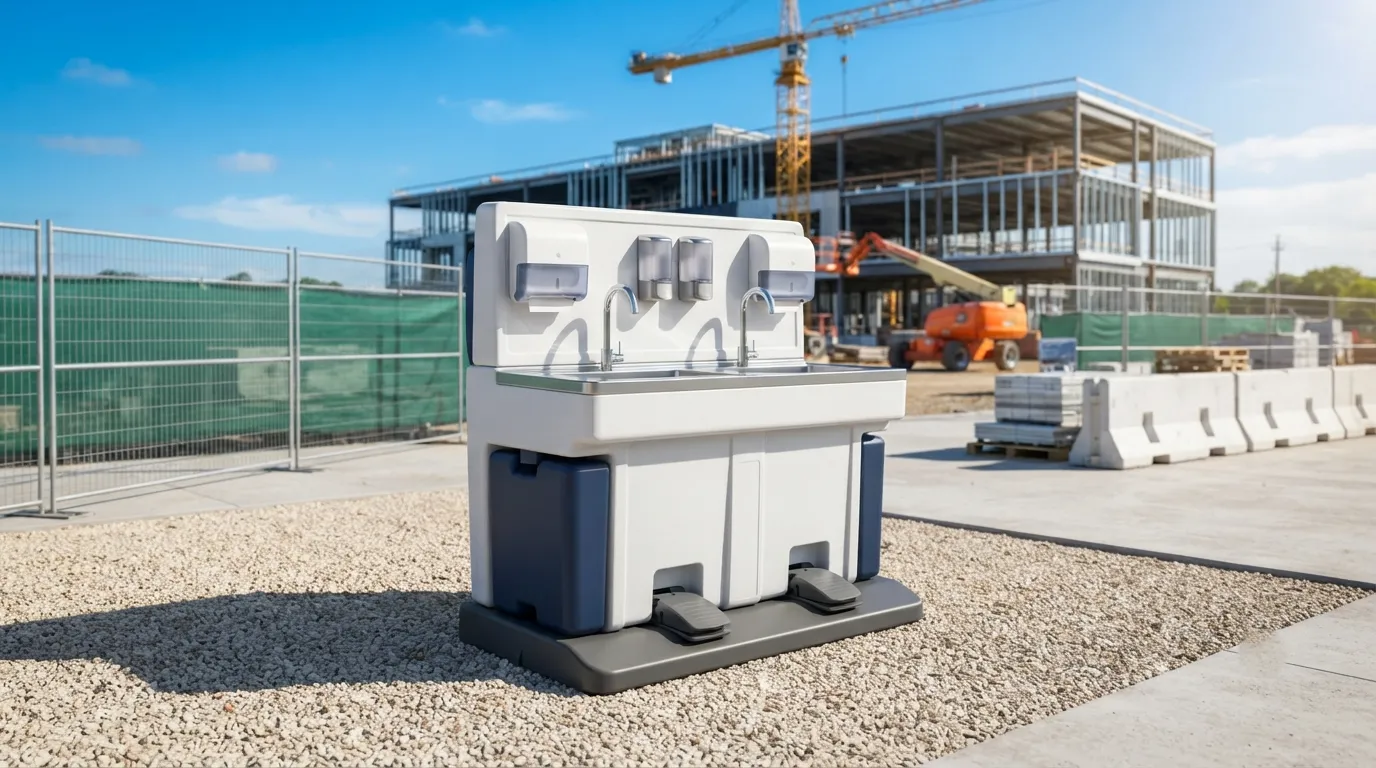
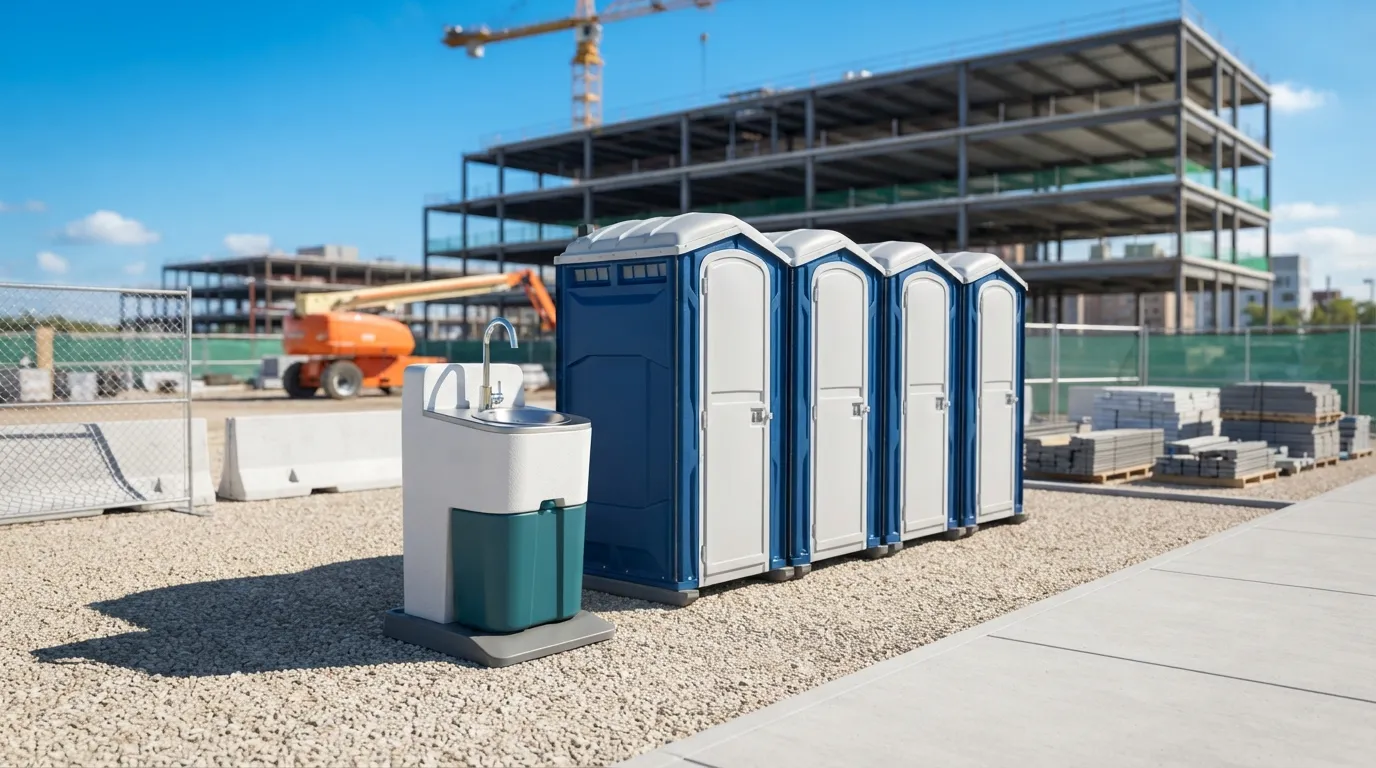
- Screened fence around the compound holding the restroom trailer and handwashing stations
- Gates staffed rather than locked, so egress is never blocked
Egress is the reason the two are not interchangeable. NFPA 101, the Life Safety Code, requires assembly occupancies to have trained crowd managers at a ratio of one per 250 occupants, and it calculates required exit width at 0.2 inches per person for level egress components. A fence line that closes off a route undermines both figures.
Philadelphia runs a dense event calendar across Fairmount Park, Penn's Landing, the stadium complex and the Wells Fargo Center, and the fencing plan for each is different because the ground is different. Grass, brick plaza and asphalt all take a base differently. Event work is set out on event restroom rental, festival restroom rental, concert restroom rental and marathon restroom rental.
What does temporary fence rental cost?
Published market data for this region puts temporary fencing at roughly $30 to $75 a day, with $50 the typical figure, and delivery and collection at $50 to $150. Those are market ranges reviewed July 2026, not a quote.
| Line | Typical range |
|---|---|
| Temporary fence, per day | $30 to $75, typically $50 |
| Delivery and collection | $50 to $150 |
| Screen, gates, stabilisers | Quoted as extras |
| Reconfiguring the line mid job | Quoted per visit |
What moves it: the length of the run, how long it stands, whether it is screened, how many gates, the ground it sits on, and how far the yard has to drive. Full breakdown on temporary fence cost, and the same distance logic applies to storage container rental cost and dumpster rental cost.
Installing, moving and taking it down
We deliver, set the line and couple it. A 200 foot run on flat, clear ground is a morning. The same 200 feet threaded around parked cars, a street tree and a stoop is a day.
What slows an install down, in order:
- Cars parked along the line, which is the number one cause everywhere in this city
- Uneven ground where bases will not sit flat
- A line drawn on a plan that does not match what is actually there
- Nobody on site with authority to move the line 3 feet
Moving panels mid job is normal and it is quoted per visit. Do not move a screened run yourself without resetting the stabilisers. ASTM F567 is the standard covering chain link fence installation, and the principle behind it applies to a rented line as much as to a permanent one: the fence only performs if it is set the way it was designed to be set.
Delivery across Philadelphia and the ring
The narrow rowhouse streets across South Philadelphia, Fishtown, Kensington and Point Breeze are where access decides everything. The truck needs a clear approach, and one parked car across the drop point ends the delivery for that day.
We cover the city and the ring around it, out to King of Prussia, Norristown, Conshohocken, Doylestown, Bensalem, Abington, Lower Merion, Haverford, Upper Darby, Chester, Camden and Cherry Hill. Distances are listed on service areas.
Questions about temporary fence rental
Can I fence a rental house or a yard?Yes, on private ground, for a defined period. If it is going to stand for years it should be a permanent fence, not a rental line.
Do panels need to be locked together?Couplers are what make a fence line rather than a row of panels. On a secure site we fit them at every joint and lock the ends.
Can the fence sit on a sidewalk?Only with the right of way approvals in place, and only if the pedestrian route still holds its width.
Do you dig posts in?No. That is a permanent fence job and a utility search. Everything we install is freestanding.
How fast can you get panels out?Same week normally, and faster on a bare perimeter. Emergencies happen, and we handle those the same way we handle emergency porta potty rental and disaster relief sanitation.
What else usually goes on a fenced site?Construction site services, portable toilet rental, storage container rental, construction dumpsters, light towers, a temporary power pole and a mobile office trailer.
Book temporary fencing
What size are temporary fence panels?
Six feet tall by around ten wide. Chain link temporary fence panels are the standard here.
Send the perimeter length, the number of gates, the term and a sketch of where the line runs. We will tell you the panel count and what the sidewalk needs before you commit. Request a quote or contact us. Also read home renovation porta potty, monthly rental, porta potty rental cost, porta potty rental in Philadelphia, the rental checklist, about us, the FAQ and the home page.
Next step
Get a delivery date
Tell us the address, the dates and the headcount. We size the order and confirm the route.