
How much does a porta potty cost to rent in Philadelphia?
A standard unit typically runs $100 to $350 per day, $125 to $250 for a weekend, and $125 to $325 per month on a jobsite. Delivery normally adds $50 to $150 and a weekly service visit $30 to $60. A deluxe flushing unit sits roughly $75 to $150 above a standard, and an accessible unit about 30 to 50 percent above.
Those are market ranges reviewed in July 2026, not a quote. Where you land inside them is mostly about access and drive time. The full breakdown, with the fees most companies bury, is on the porta potty rental cost page.
How many porta potties do I need?
On a construction site, OSHA 1926.51(c)(1) requires one toilet for 20 or fewer workers, then one toilet seat and one urinal for every 40 workers above that. It counts people on site rather than contractors, so a rowhouse rehab with a framer, an electrician and a plumber counts all three.
For an event, the working rule is one unit per 50 guests over four hours, plus 15 to 20 percent where alcohol is served, plus at least one accessible unit. The sizing calculator runs both, and the OSHA guide covers the jobsite rule in full.
Do I need a permit for a porta potty in Philadelphia?
On private property, no. Behind your rowhouse, in a rear yard, on a private lot, no permit applies.
For an event or a placement on public ground in Philadelphia, yes, and the route surprises people. Portable toilet permits are issued by the Department of Public Health under its infectious waste program, on the same application that covers holding tanks, rather than by a streets or transportation department. Contractors who go looking at Streets first routinely lose a couple of days that way. Outside the city line each township and borough sets its own rule, and there is no single county answer. The permit requirements page walks the whole route, and dumpster permits are handled separately again.
How often is a porta potty serviced?
Weekly as standard. ANSI/PSAI Z4.3, the industry standard for non-sewered waste disposal systems, treats one visit a week as the baseline under normal use, and that is what we schedule unless the traffic on the unit says otherwise.
A service visit is not a wipe down. The truck pumps the holding tank out, rinses it, recharges the deodoriser, restocks paper and sanitiser, and wipes the touch surfaces. Volume decides frequency rather than politeness: a 60 gallon tank holds over 500 pounds at 8.34 pounds per gallon, so a busy crew or a festival bank needs a mid-run visit rather than a bigger cabin. More detail on how often units are cleaned.
Do porta potties smell?
Not on schedule. Smell is a servicing gap, not a defect in the unit. The blue deodoriser in the tank suppresses odour for a set number of uses, and once it is spent the tank starts talking regardless of how new the cabin is.
Placement helps more than people expect. A unit in full afternoon sun works harder than one in shade, and a door facing into prevailing wind clears the vent stack faster. The honest version of the whole answer, plus what is actually happening inside the tank, is on do porta potties smell.
How fast can you deliver in Philadelphia?
Next working day on most standard units, and same day is often possible on a Center City or South Philly address if you call early. Restroom trailers and multi-unit event orders need three to five days, because they get scheduled around the venue rather than around the truck.
Stock is almost never what slows a Philadelphia delivery down. Access is. For genuine urgency see emergency porta potty rental, which sets out what can actually be turned around and what cannot.
What happens if the truck cannot get down my street?
Tell us the block before we load and it usually does not come up. Most of Philadelphia is rowhouse streets, narrow, parked solid both sides, often one-way, and one car in the wrong spot can stop a delivery outright.
If a delivery fails on arrival because of access, re-delivery is normally chargeable, which is why we ask about the street rather than the zip code. A standard cabin is only about 44 by 48 inches with a 92 inch height on the common manufacturer models, so the unit fits nearly anywhere. Getting the truck alongside it is the part that fails. The placement guide has the clearances we work to.
Can the unit go in a back yard?
Usually, but it changes the job. At 150 to 200 pounds empty, walking a cabin through a house or down a shared alley is a two person lift, and it has to come back out the same way at the end. Service access matters just as much: the pump hose has a working reach, so a unit placed 80 feet from where the truck can stop is a problem every week, not once.
Say rear yard when you book rather than on delivery day. We price it differently and honestly.
How long can I keep a porta potty?
One day to several years. Past about ten days, ask for monthly pricing, because the per-day rate drops hard once it moves to a standing schedule. Rowhouse renovations in Fishtown and Kensington routinely run single units for six or nine months, which is a different product from a weekend rental even though it is the same cabin. See monthly jobsite rental.
What is the difference between a standard, deluxe and ADA unit?
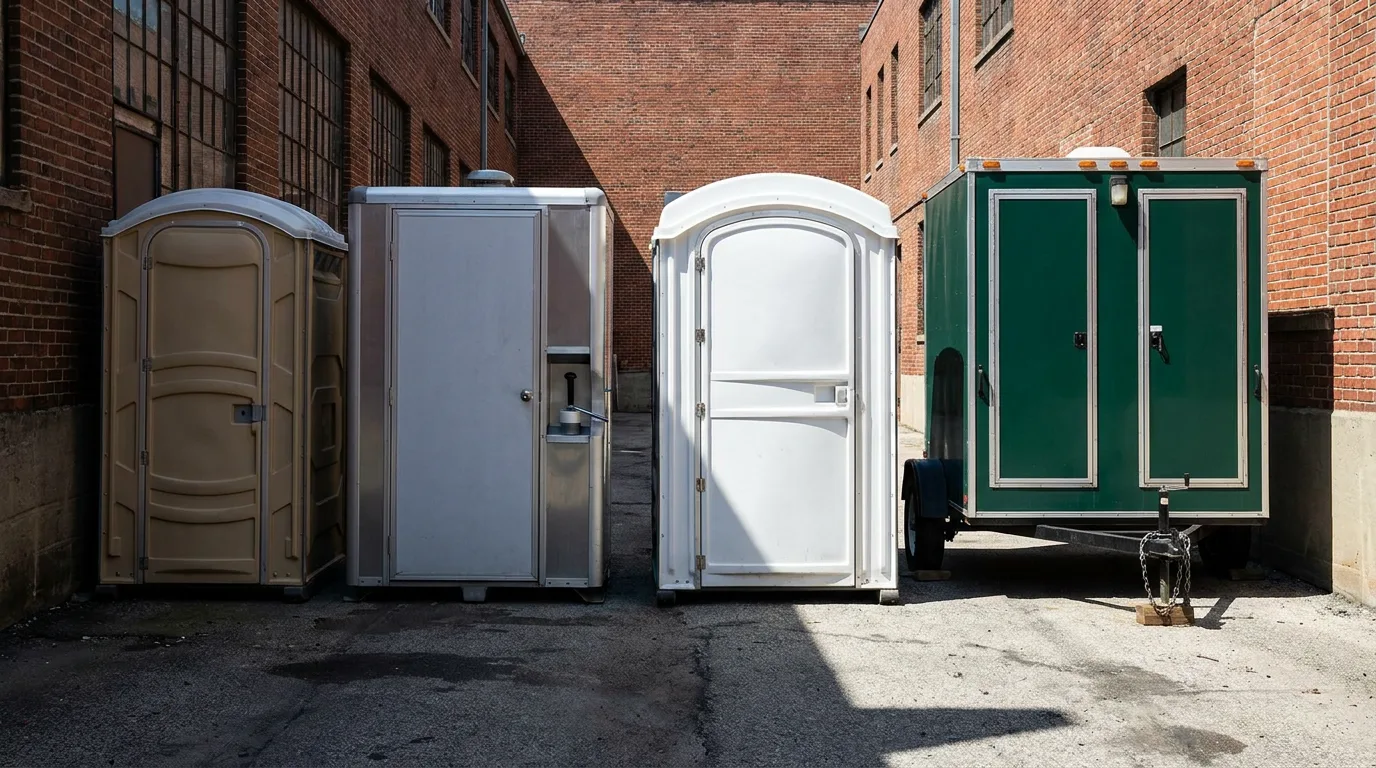
A standard porta potty is a single chemical toilet over a sealed holding tank with no running water, tank capacity between 60 and 70 gallons on the usual models. Porta john, portable toilet, portable restroom, port a potty: same box, four names.
A deluxe flushable unit adds a foot pump flush off a reservoir manufacturers spec near 5 gallons, plus a mirror and a sanitiser dispenser.
An ADA accessible unit is roughly 62 inches square with a ground level entry, because the 2010 ADA Standards require a 60 inch turning space in section 304.3.1 and a 32 inch clear door opening in 404.2.3. Any event open to the public needs at least one. See ADA restroom requirements for the counts.
When should I book a restroom trailer instead?
When a standard unit would embarrass you. A restroom trailer is a towable unit with flushing toilets, sinks with running water and climate control, used where portable cabins would be inadequate. Weddings, corporate events, film sets and long deployments where crews need somewhere decent.
Sizes run from two stall through four and eight, with luxury and shower trailers above that. Every trailer needs services: manufacturer specs on a two stall want a dedicated 20 amp 110 volt circuit and hold roughly 100 gallons of freshwater, so a field with no power means a generator in the quote. Weekend pricing typically starts near $900 and climbs with stall count. See restroom trailer cost.
Do you deliver outside Philadelphia?
Yes, out to roughly 26 miles in every direction, covering Montgomery, Bucks and Delaware counties plus the New Jersey side of the river. Camden is 7.3 miles out, King of Prussia
17.3, and Doylestown 26.2 at about a 48 minute drive.
Distance is not the same as difficulty. A 22 minute run to Abington is often easier than a 15 minute crawl into South Philadelphia, because the far one has a driveway and the near one has cars parked both sides. Every suburb with its real drive distance is listed on service areas.
What changes in winter?
Chemistry and access. The tank additive has to handle freezing, doors and hinges need working, and a unit placed where snow gets ploughed against it becomes unusable for a week. Jobsites keep running through January in this region, so the units stay out.
Servicing gets harder before it gets more expensive: a truck cannot pump a frozen line. Read porta potties in winter before a cold weather start, and note that OSHA
1926.51(f) still requires washing facilities in February, which usually means a handwashing station rather than a hose.
Do you rent anything besides toilets?
Most sites need more than one thing on the truck, and one movement beats four.
- Roll off dumpsters in 10, 20, 30 and 40 yard sizes. A 20 yard box runs roughly 22 feet by 8 feet by 4.5 feet, which on a rowhouse street means it sits in the roadway rather than on a driveway.
- Temporary fencing in chain link panels, typically 6 feet tall by 12 feet wide, plus crowd control barriers for events.
- Storage containers in 20 foot and 40 foot sizes, and mobile office trailers for longer sites.
- Septic pumping, tank cleaning, grease trap work and holding tank rental, which matter more in the outer townships than inside the city.
- Light towers and temporary power poles, which turn up on winter jobsites more than summer ones.
What should be included, and what should not be an extra?
Delivery, the unit, the agreed service visits and pickup belong in the quote and should be listed separately so you can see them. Paper, sanitiser and the deodoriser charge are part of a service visit, not line items. Standard placement within reach of where the truck can stop is not a surcharge.
What genuinely can cost extra: a failed delivery caused by blocked access, a mid-run service visit you ask for on top of schedule, weekend collection, a walked-in placement, and a move once the unit is already sited. Ask which of those apply before you sign anything.
Still have a question?
Request a quote with the address and dates, contact us to talk it through, read about the company, check porta potty rental in Philadelphia for the neighbourhood detail, or start again from the home page.
Next step
Get a delivery date
Tell us the address, the dates and the headcount. We size the order and confirm the route.