
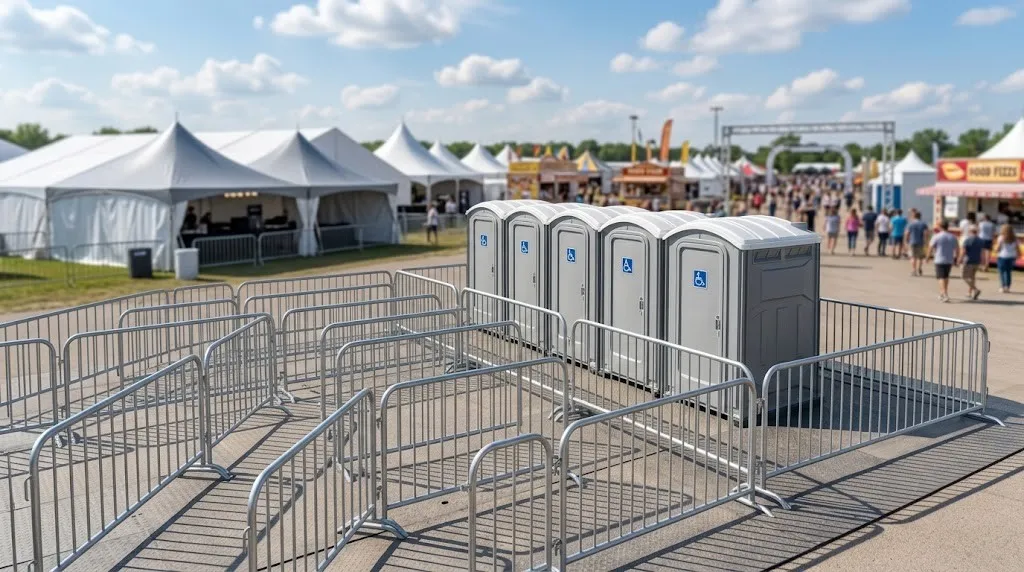
What is a crowd control barrier?
A crowd control barrier is a freestanding steel frame, commonly called a bike rack barrier, with hooked ends that interlock into the next unit so a run of them behaves as a continuous line. It channels people, holds a front of house line and keeps a route clear without enclosing anything.
It is a different tool from site fencing and the two are not interchangeable. Chain link panels build a perimeter you cannot see through or climb easily. Barriers build a line people stand against and staff work from both sides of. Site perimeter is on temporary fence rental and chain link fence panels.
Barrier specification
| Element | Typical spec |
|---|---|
| Length | 8 ft 6 in |
| Height | About 43 in |
| Weight | Roughly 35 to 45 lb |
| Material | Powder coated or galvanised steel |
| Connection | Interlocking hook and eye, no tools |
| Feet | Flat or bridge foot |
The flat foot sits on paving without a trip hazard on the crowd side. The bridge foot lifts the bottom rail clear of a cable run, which is what you want when audio and power lines cross the line at a stage.
Barriers are stacked and moved by hand, so a long run is a manual job. Two people can set 100 feet in minutes on flat ground. The same 100 feet across the cobbles and trolley track surfaces you find in parts of Old City takes longer and needs more attention to where each foot lands.
How many barriers do I need?
Divide the run by 8.5 and round up. Then add for gates, corners and any point where the line has to break for egress.
| Line to cover | Barriers |
|---|---|
| 50 ft | 6 |
| 100 ft | 12 |
| 250 ft | 30 |
| 500 ft | 59 |
| 1,000 ft | 118 |
Those counts assume a straight run. A corner costs you the same as a panel, a staffed gap costs you two, and a queue serpentine will use more than the tape suggests because every turn wastes length.
Send a site plan with the line drawn on it and we will count it. The same principle applies to working out how many units you need for the same crowd.
Egress, crowd managers and the rules that apply
A barrier line is a life safety element, not just furniture. NFPA 101, the Life Safety Code, requires assembly occupancies to have trained crowd managers at a ratio of one per 250 occupants, which is the figure most event plans in this city are built around.
Egress capacity is written down too. NFPA 101 calculates required exit width using a factor of 0.2 inches per person for level egress components and 0.3 inches per person for stairs. Run that against your expected attendance before you decide where the line breaks, not after.
Practical rules that follow from it:
- Egress gaps are staffed, never locked or tied
- The gap is wide enough for people to move through at a walk, not single file
- Barriers never enclose a space with only one way out
- The line does not block a fire lane or a hydrant
OSHA 1926.202 requires barricades used to protect employees to conform to the Manual on Uniform Traffic Control Devices, which is the standard behind how work zones and closures are marked. If your barrier line touches a roadway, that is the rulebook.
Accessible viewing and clear routes
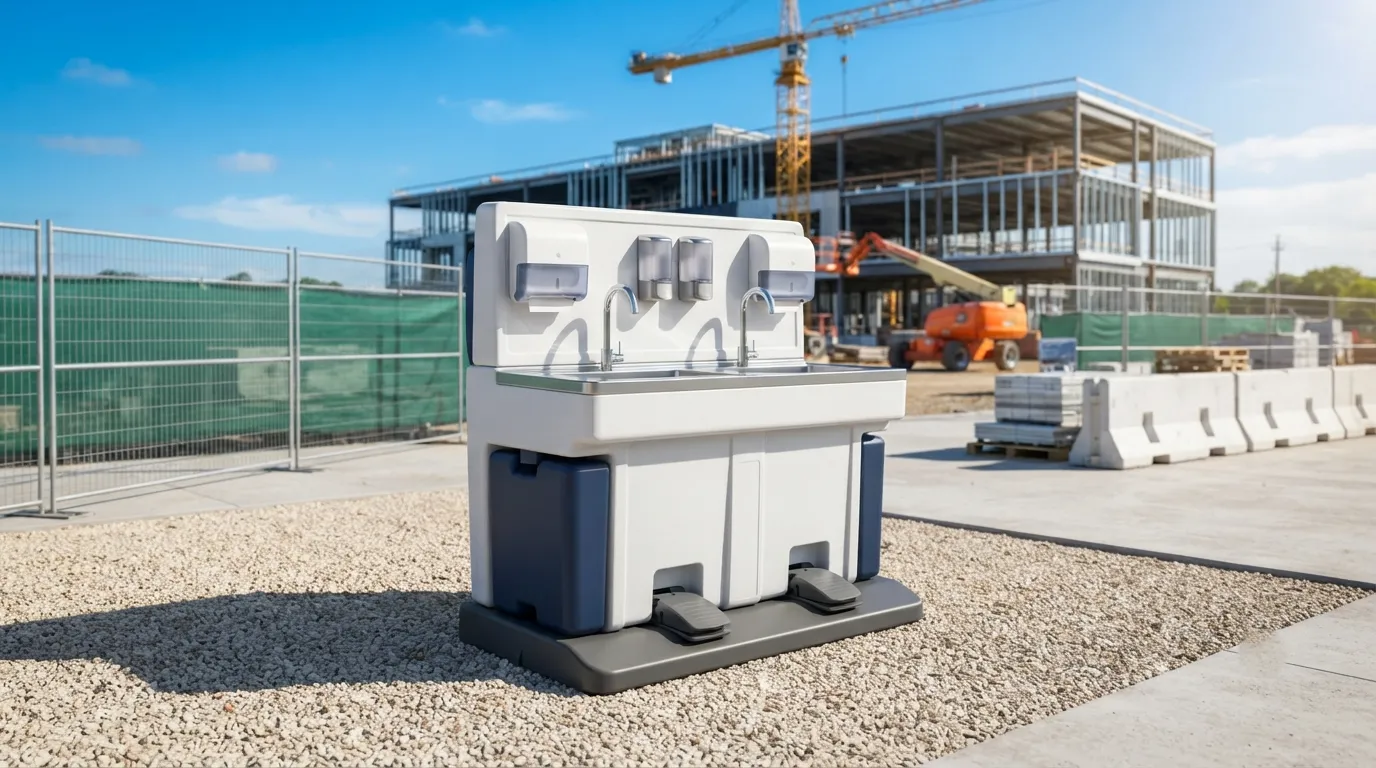
The 2010 ADA Standards for Accessible Design require wheelchair spaces in assembly areas under section 221, with lines of sight over standing spectators addressed in section 802. A barrier line that puts every wheelchair user behind a wall of standing people has failed that, regardless of how many spaces were counted.
On routes, the same standards set a minimum clear width of 36 inches for an accessible route in section
403.5.1. A barrier foot sticking into a walkway counts against that width, which is why flat feet go on the public side.
Put the accessible viewing area where the sight line is real and next to the accessible facilities, which usually means beside the ADA accessible units rather than at the far end of the site. Full detail on ADA restroom requirements.
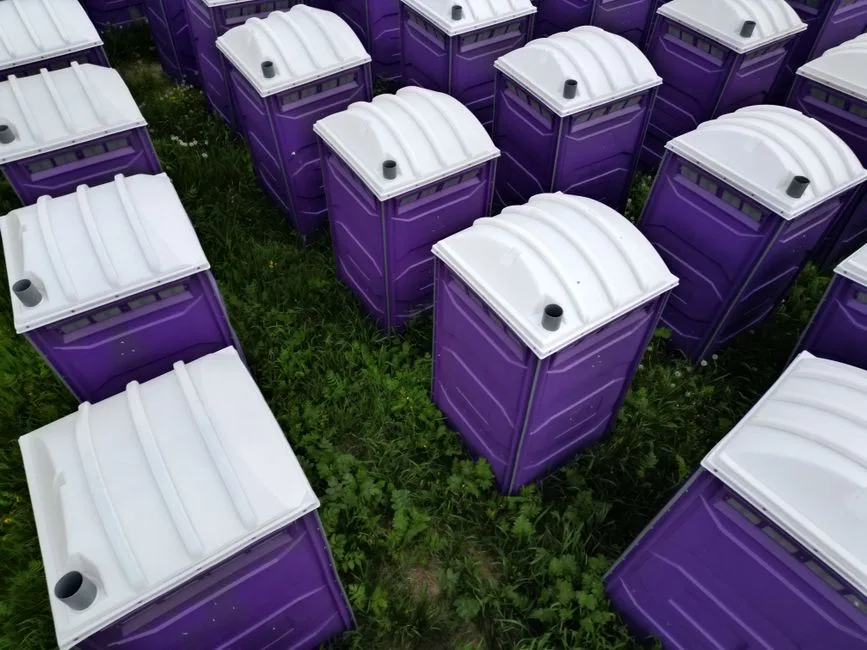
Laying out a line at a Philadelphia venue
Every venue in this city has its own problem. Fairmount Park is grass and slopes. Penn's Landing is brick plaza and wind off the river. The stadium complex around Lincoln Financial Field and Citizens Bank Park is asphalt and long sight lines. The Wells Fargo Center is a controlled envelope with its own procedures. Street events on Broad Street bring parked cars, trolley infrastructure and crossings.
What we ask before a barrier order:
- Where the stage, the entrance and the exits are
- Expected attendance, which drives egress width
- Where vehicles need to cross the line
- Whether the ground is grass, brick, asphalt or cobble
- What time the line has to be standing by
Event sanitation runs alongside it: event restroom rental, festival restroom rental, concert restroom rental, marathon restroom rental and county fair restrooms all cover the unit side.
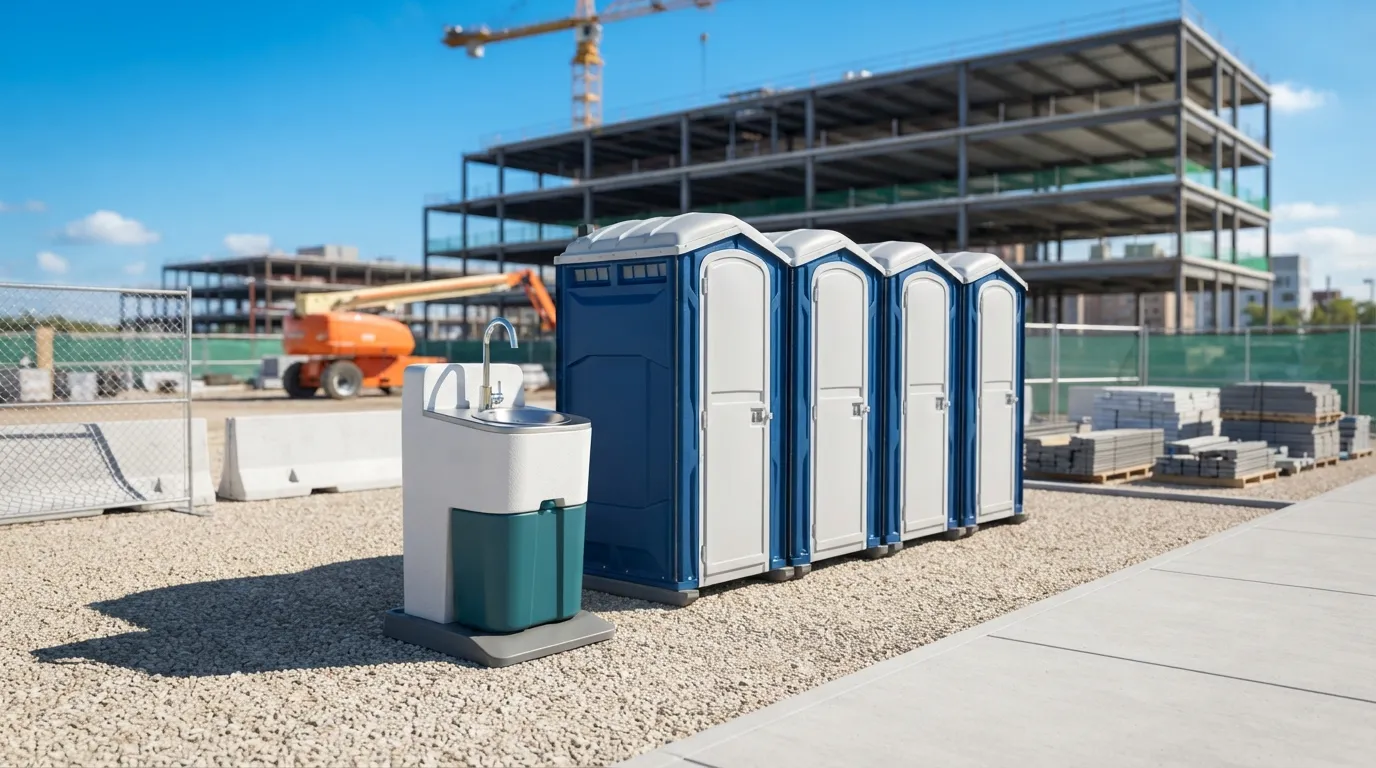
What does crowd control barrier rental cost?
We quote barrier per job, because there is no published market band for bike rack barrier in this region that we would stand behind, and inventing one would be worse than saying so. What drives it is the number of barriers, the term, the delivery window and how far the yard drives.
For reference, published market data for temporary fencing in this region runs $30 to $75 a day with $50 the typical figure, and delivery and collection $50 to $150, reviewed July 2026. Barrier sits in a different place, and one order with the fencing and the units on it will always beat three separate deliveries. Cost detail on temporary fence cost and porta potty rental cost.
Questions about crowd control barriers
Can barriers be used as a site fence?No. They are 43 inches high, see through and easy to step over. Use chain link panels for a perimeter.
Do you fit banner covers?Barrier jackets are common at events and they change the wind behaviour of the line, so they need to be tied properly rather than draped.
Can they go on grass?Yes. On soft ground after rain the feet sink, so plan for a slightly uneven line in Fairmount Park in spring.
Do I need a permit?Street events in Philadelphia need approvals for the street itself. Separately, portable toilet and holding tank applications here go to the Department of Public Health under its infectious waste program rather than to a streets department, which is set out on porta potty permit requirements.
What else goes out for an event?Usually portable toilet rental, handwashing stations, hand sanitizer stands, restroom trailer rental, light tower rental and a storage container for back of house.
Book crowd control barriers
Send the line length, the attendance, the venue and the set time. We will count the barriers and flag the egress gaps before you commit. Request a quote or contact us. Also read wedding restroom rental, golf tournament restrooms, service areas, porta potty rental in Philadelphia, the FAQ and the home page.
Next step
Get a delivery date
Tell us the address, the dates and the headcount. We size the order and confirm the route.