
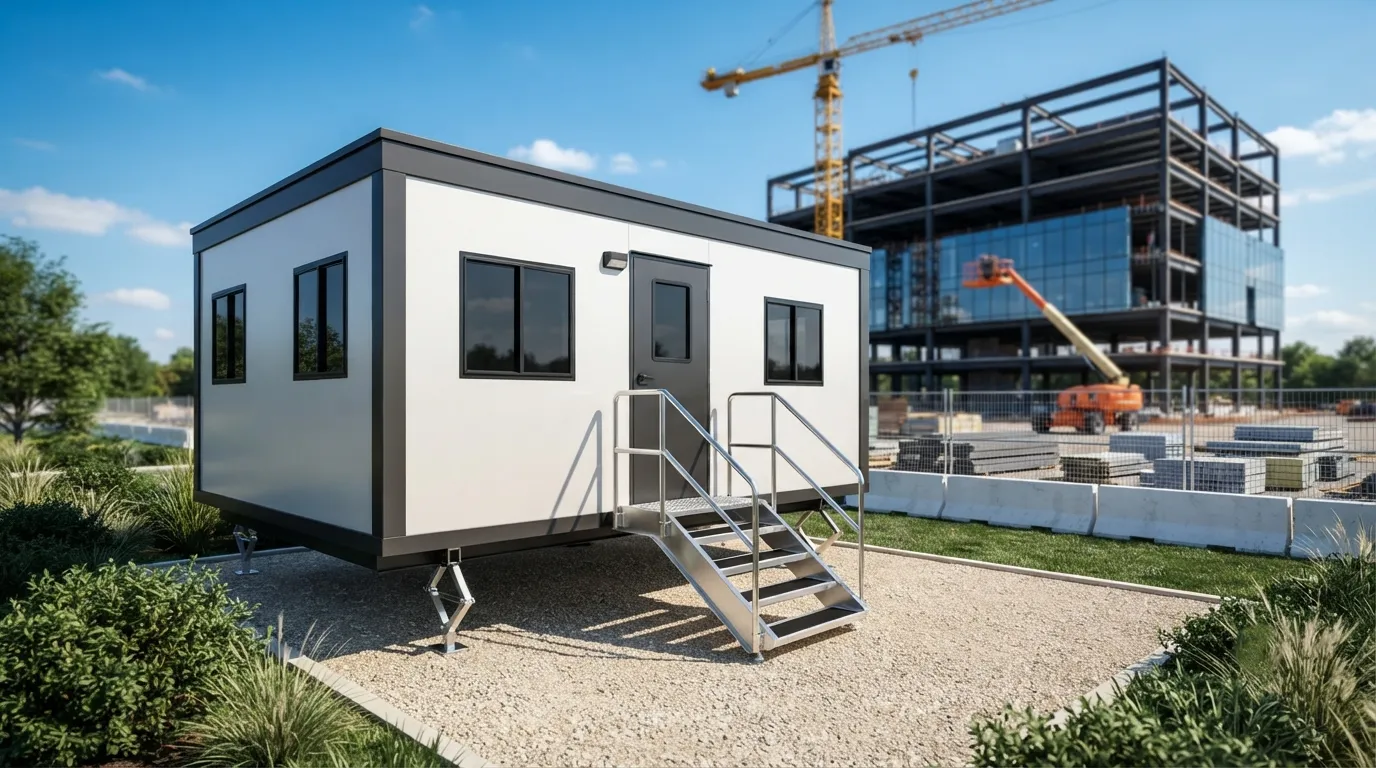
What is a mobile office trailer?
A mobile office trailer is a factory built office on a steel chassis, towed to your site, set level on blocks and connected to power, so it functions as a permanent office for the length of a project without anything being constructed on the ground.
Inside a standard unit you get partition walls, vinyl or carpet floor, fluorescent or LED lighting, HVAC, lockable entry and a plan table or desks. Nothing about it is temporary except the fact that it leaves.
It is not the same product as a shipping container with a door cut in it. A container conversion is a ground level office with no steps and no chassis. A trailer sits high, needs stairs or a ramp, and is far better insulated. Choose on access first and comfort second.
Sizes and what each one actually holds
| Size | Floor area | Realistic occupancy | Typical use |
|---|---|---|---|
| 8 x 20 | 160 sq ft | 2 people | Small rowhouse job, gatehouse |
| 10 x 40 | 400 sq ft | 4 to 6 people | Mid size build, one meeting corner |
| 12 x 50 | 600 sq ft | 6 to 8 people | Full site team |
| 12 x 60 | 720 sq ft | 8 to 10 people | University and hospital projects |
| 24 x 60 doublewide | 1,440 sq ft | 15 plus | Large compounds, two joined units |
The doublewide arrives as two halves and is joined on site, which means two deliveries and a set day. Budget a day for the mate up before you plan a meeting in it.
Occupancy figures above are what the space actually works at with desks in it, not a code maximum. Cram more in and the HVAC becomes the complaint by August.
What does an office trailer weigh, and how does it get delivered?
An 8 by 20 runs roughly 5,000 to 7,000 pounds and a 12 by 60 roughly 14,000 to 18,000 pounds depending on build and fit out. It arrives on its own axles behind a truck rather than on a flatbed, which changes what the approach has to look like.
Width is the gate. PennDOT requires a hauling permit for any vehicle or load exceeding 8 feet 6 inches in width, so every unit from 10 feet up is a permitted move with a routed path, and a 12 wide through the city core needs planning rather than a phone call the day before.
What we need to know before we quote a delivery:
- The route in, including any low bridge or overhead wire
- The turning circle at the site entrance
- Whether the final position is reachable in one straight back up
- Ground conditions where the blocks go
- Whether anything has to come out of the way, like a fence panel
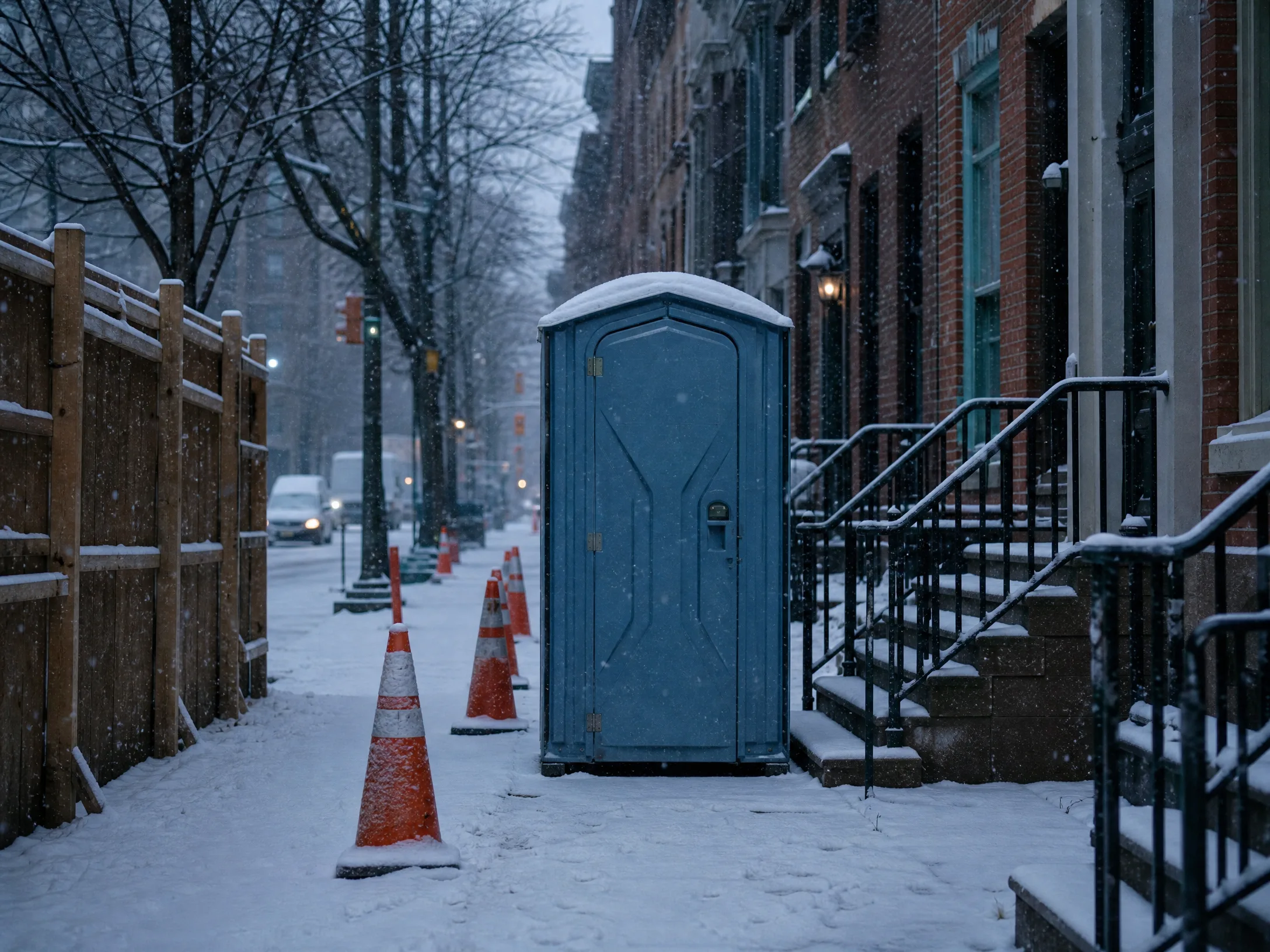
On the narrow rowhouse blocks across South Philadelphia, Fishtown and Kensington, a 12 wide is usually not happening. An 8 by 20 often is, and a container office almost always is. See the placement guide for ground and access notes.
Setting up: blocks, tie downs and steps
The trailer sits on stacked blocks under the chassis frame, levelled with shims, then tied down. Setup is where most of the on site time goes, and it is what stops doors sticking three weeks later.
The standard set includes:
- Block and level on compacted ground or plates
- Tie down anchors, because a light empty box in a February wind is a real load
- Steps at each door, or a ramp where access requires one
- Skirting where the site wants it
- Power connection by your electrician, not by us
Philadelphia clay holds water and moves through a freeze and thaw. A trailer that goes down level on soft ground in November will need re levelling in spring, so blocks go on plates unless the surface is hard.
Power, heat and light
The trailer needs a service before it is any use. Most units take a 100 amp or 200 amp single phase feed and run HVAC, lighting and outlets from an internal panel.
If the site has no permanent service yet, the answer is a temporary power pole or a generator, and it needs a licensed electrical contractor under permit. Temporary wiring on a construction site falls under Article 590 of the National Electrical Code, and 590.6(A)(1) requires GFCI protection on 125 volt, single phase, 15, 20 and 30 ampere receptacle outlets used for temporary power.
Lighting levels are written down too. OSHA 1926.56(a) and its Table D-3 require 30 foot candles in offices and first aid stations on a construction site, against 5 foot candles for general construction areas. That is a real gap, and it is why site offices get proper lighting rather than a string of temporary lamps. Outside the door, a light tower covers the compound.
Bathrooms in a mobile office trailer
Some units come with a lavatory. It only works if you have both a water supply and a way to take the waste away, which most active Philadelphia sites do not have on day one.
The workable answers, in the order people actually choose them:
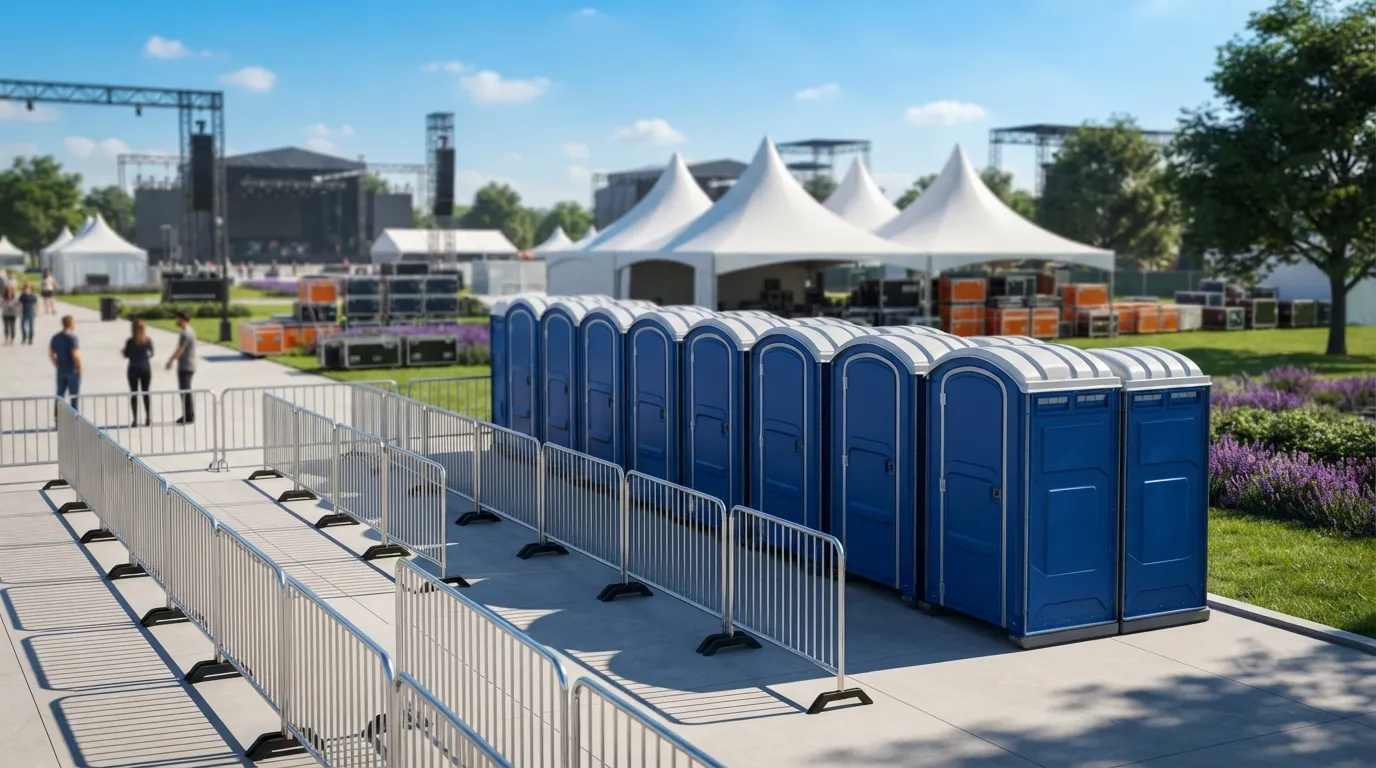
- Portable units outside the office, serviced weekly. Simplest and cheapest.
- A trailer lavatory plumbed to a holding tank, pumped on a schedule
- A restroom trailer beside the office, which is what happens on longer builds
- A shower trailer as well, on projects with a resident crew
OSHA 1926.51(c)(1) sets the toilet requirement at one unit for 20 or fewer workers on the site, so the office lavatory does not remove the need for site toilets. Ratios are worked through on OSHA portable toilet requirements and the sizing calculator.
Do I need a permit for a mobile office trailer in Philadelphia?
Usually yes, and it is worth starting early. Pennsylvania's Uniform Construction Code, Act 45 of 1999, is what a placed modular building is inspected against, and in Philadelphia the permit and inspection come from the Department of Licenses and Inspections rather than from the state directly.
Two things people underestimate. The electrical connection needs its own permit and a licensed electrical contractor. And the trailer's position on the lot is a zoning question as well as a building one, so a compound plan that was fine on paper can move 15 feet in practice.
For contrast, the routing that is genuinely unusual in this city is portable sanitation. Portable toilet and holding tank applications go to the Department of Public Health under its infectious waste program rather than to a streets or transportation department, which is set out on porta potty permit requirements. Skips run separately again through dumpster permit requirements.
ADA access and the ramp
If the public, an inspector or a client will use the trailer, the entrance has to be reachable. The 2010 ADA Standards cap a ramp running slope at 1:12 in section 405.2, hold the maximum rise per run to 30 inches in
405.6, require a clear ramp width of 36 inches in 405.5, and call for handrails on any ramp rising more than 6 inches in 405.8.
A 1:12 slope means a trailer floor 30 inches off the ground needs 30 feet of ramp, plus landings. That is a lot of compound, and it is the single most common surprise on a city site. Plan the ramp footprint at the same time as the trailer position, not after. Related reading: ADA restroom requirements and ADA accessible porta potty.
Renting, buying and used trailers
We rent. We do not sell used office trailers, and we do not broker them, because a used unit is a building you are buying sight unseen and the good ones rarely reach the open market.
If a project runs long enough that buying looks cheaper, say so and we will quote a long term rate rather than let you work it out from a monthly figure. Long terms price below short ones, the same way they do on monthly porta potty rental and what a container costs by the month.
What does a mobile office trailer cost?
It is quoted per job, and we do not publish a rate we cannot stand behind for your site. What drives it is size, term, delivery distance, the permitted move if the unit is over 8 feet 6 inches wide, and the setup work at your end.
What we can put numbers against, because there is published market data for it, is the rest of the compound: containers at $100 to $250 a month with $125 typical, delivery and collection at $50 to $150, and weekly service on portable units at $30 to $220 with $60 typical. Those are market ranges reviewed July 2026, not quotes. See storage container rental cost and porta potty rental cost.
Questions about mobile office trailers
How long does setup take?A single wide, a few hours. A doublewide, most of a day once both halves are on site.
Can it go on grass?On firm compacted ground with plates under the blocks, yes. On soft ground after a wet week, no.
Is it insulated?Yes, and better than a container conversion. HVAC does the rest.
Can you deliver to a rowhouse block?An 8 by 20 sometimes. Anything wider, rarely. Send a photo of the approach and we will tell you straight.
What else goes on the compound?Usually construction site services, storage containers, temporary fence rental, handwashing stations and construction dumpsters.
Book a mobile office trailer
Can I rent mobile office trailer space by the month?
Yes. Most Philadelphia sites take a mobile office trailer for the length of the build.
Is there a small mobile office trailer for tight sites?
Yes, from around 8 by 20 feet. Mobile office trailer near me searches usually want this size.
Is there a mobile office trailer with bathroom?
There is, on larger units. It needs a holding tank and a service schedule.
Tell us the size, the term, the site address and what the approach looks like. We will tell you whether the unit fits before anything is booked. Request a quote or contact us. Also read 40ft storage containers, crowd control barriers, service areas, porta potty rental in Philadelphia, about us, the FAQ and the home page.
Next step
Get a delivery date
Tell us the address, the dates and the headcount. We size the order and confirm the route.