
What is the septic tank pumping frequency table?
The estimated pumping frequency table is a published grid of years between pump outs, read across tank capacity and household size. Penn State Extension publishes the version used across Pennsylvania, and the figures below are the ones the townships around Philadelphia work from.
| Tank size | 1 person | 2 people | 3 people | 4 people | 5 people | 6 people |
|---|---|---|---|---|---|---|
| 500 gallons | 5.8 yrs | 2.6 yrs | 1.5 yrs | 1.0 yrs | 0.7 yrs | 0.4 yrs |
| 750 gallons | 9.1 yrs | 4.2 yrs | 2.6 yrs | 1.8 yrs | 1.3 yrs | 1.0 yrs |
| 1,000 gallons | 12.4 yrs | 5.9 yrs | 3.7 yrs | 2.6 yrs | 2.0 yrs | 1.5 yrs |
| 1,250 gallons | 15.6 yrs | 7.5 yrs | 4.8 yrs | 3.4 yrs | 2.6 yrs | 2.0 yrs |
| 1,500 gallons | 18.9 yrs | 9.1 yrs | 5.9 yrs | 4.2 yrs | 3.3 yrs | 2.6 yrs |
Read your own row, not the average. A 1,000 gallon tank is the common residential size around here, and 25 Pa. Code Chapter 73, the Department of Environmental Protection standards for onlot sewage treatment facilities, sets the minimum capacity by bedroom count, so a four bedroom house often has more than 1,000 gallons in the ground. Your original permit paperwork will say.
What shortens the interval?
Anything that puts more solids or more water through the tank. The table assumes an ordinary household without unusual loads, and plenty of houses are not that.
- A garbage disposal, which is the single biggest accelerator, since it sends food solids straight to a tank designed for settling rather than digestion
- A household that grew, because the table is per person and one extra occupant moves you a whole column
- Laundry concentrated on one day rather than spread across the week
- A water softener discharging into the system
- Flushing wipes, even the ones marked flushable, along with grease from the kitchen
- A rental property where occupancy changes and nobody tracks the last service date
Cut in the other direction and the interval stretches. A weekend house used forty days a year is not on the same schedule as a full time one. The consequences of getting this wrong show up first as the symptoms on septic tank warning signs.
How do I tell without using the table?
Measure the layers. The standard rule, published by the EPA and by extension services, is to pump when the top of the sludge layer comes within 12 inches of the bottom of the outlet baffle, or when the bottom of the floating scum layer comes within 3 inches of it.
That is what a proper inspection measures, and it is the reason the EPA recommends inspection every three years even when pumping is on a five year cycle. The measurement tells you where you actually are rather than where the table says you should be. It also catches the failure the table cannot see, which is a liquid level standing above the outlet invert because the drainfield has stopped accepting flow.

Do Philadelphia area townships require pumping on a schedule?
Some do. Pennsylvania's Sewage Facilities Act, Act 537 of 1966, makes each municipality responsible for planning its own sewage facilities, and a number of townships around the city run sewage management programs under that plan which require proof of pumping on a fixed cycle, commonly every three years.
There is no single Montgomery County or Bucks County answer, and there is no state wide one either. Call your township or the local sewage enforcement officer before assuming you are on your own schedule. If you are selling the property, the pumping record is usually part of the transaction paperwork. Keep the receipts.
Does any of this apply inside the city?
Mostly not, and this is where Philadelphia differs from the counties around it. The Philadelphia Water Department serves the city, with roughly 60 percent of it draining through a combined sewer system that carries stormwater and sanitary flow in the same pipe, which is what the Green City, Clean Waters program has been addressing since 2011.
What sits in the ground on a city property, when anything does, is usually a sealed holding tank rather than a septic tank. Holding tanks are not on a multi year cycle at all. They fill at a rate set by usage and get pumped in weeks, sometimes days. See holding tank rental and service, and note that the city's portable toilet and holding tank application is issued by the Department of Public Health under its infectious waste program rather than by a streets department.
How often for a commercial system?
More often, and on a schedule set by flow rather than by occupants. A restaurant, a banquet room or a daycare puts a different load through a tank than a family does, and grease is the variable that changes everything. Kitchen waste belongs in an interceptor, not in a septic tank, which is what grease trap pumping covers.
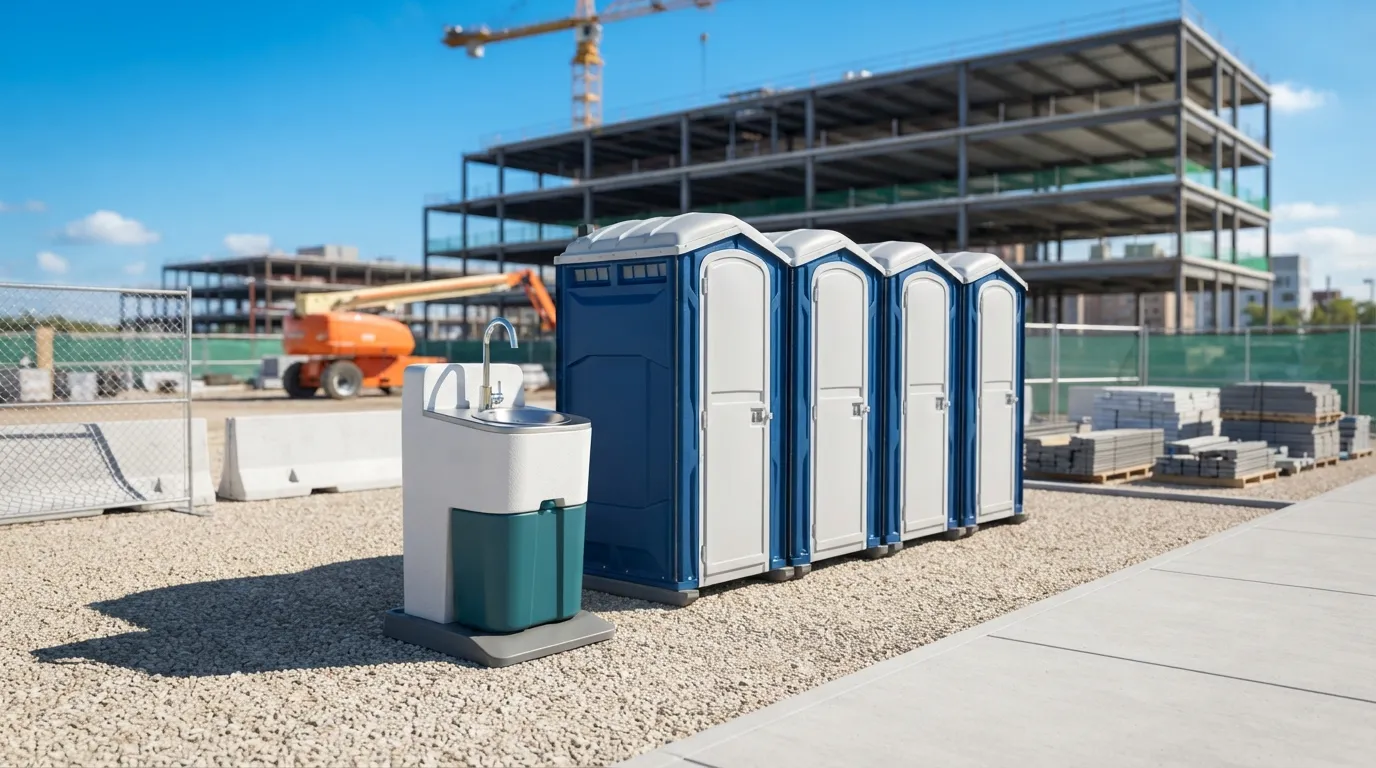
Construction sites are a separate question again. They rarely have a tank, they have crews, and OSHA
1926.51(c)(1) requires one toilet for 20 or fewer workers with one toilet seat and one urinal for each 40 above that. Servicing on rented units follows ANSI/PSAI Z4.3, which treats a weekly visit as the baseline. The sizing calculator and OSHA requirements handle that side.
What happens if you skip it?
Solids reach the outlet and go where they were never meant to go. Once a drainfield is loaded with sludge the soil pores blind over, and the repair is measured in thousands rather than hundreds. A pump out sits at $150 to $300 in this market. That is the whole argument.
The other failure is slower and quieter. A tank that has not been opened in a decade often has a corroded lid, a cracked baffle or a filter that stopped working years ago, and none of those announce themselves until a fixture backs up. Everything the visit should cover is on septic tank cleaning, and the numbers are on septic tank pumping cost.
Where the septic work sits around Philadelphia
The tanks are in the ring, not in the city. Drive distances from Philadelphia, all inside our normal service radius:
| Area | Miles | County |
|---|---|---|
| Camden, NJ | 7.3 | Camden |
| Abington | 8.6 | Montgomery |
| Lower Merion | 11.4 | Montgomery |
| Upper Darby | 11.5 | Delaware |
| Haverford | 11.9 | Delaware |
| Conshohocken | 13.5 | Montgomery |
| Cherry Hill, NJ | 13.6 | Camden |
| Bensalem | 14.8 | Bucks |
| King of Prussia | 17.3 | Montgomery |
| Norristown | 18.8 | Montgomery |
| Chester | 22.6 | Delaware |
| Doylestown | 26.2 | Bucks |
Because permitting sits with the municipality rather than the county under Act 537, the pumping rule can change the moment you cross a township line. Two houses four miles apart can be on different obligations. The Philadelphia page covers what the city itself is like to work in.
Questions about pumping frequency
Do additives extend the interval?No. The EPA is direct about this in its SepticSmart material. Nothing poured down a drain removes the inorganic solids that settle on the floor of the tank.
Does a bigger tank mean I can forget about it?It buys years, not permanence. A 1,500 gallon tank with two people is still on a nine year cycle rather than never.
We just bought the house and have no records. Treat it as due. Pump it, get the tank located and the size confirmed, then start the clock properly.
Does heavy rain change anything?It changes what the drainfield can accept. Philadelphia averages about 41 inches of precipitation a year on NOAA's normals, and a saturated field in spring will back a system up even with an empty tank. That is when emergency septic calls spike.
Who do I call to get it done?Us. Septic pumping service explains the visit, service areas shows the ring, and you can request a quote or contact us directly. The FAQ and the home page cover everything else we run.
How often septic tank cleaning is needed?
Same interval as pumping. Septic tank cleaning frequency follows sludge depth, not the calendar.
Next step
Get a delivery date
Tell us the address, the dates and the headcount. We size the order and confirm the route.