
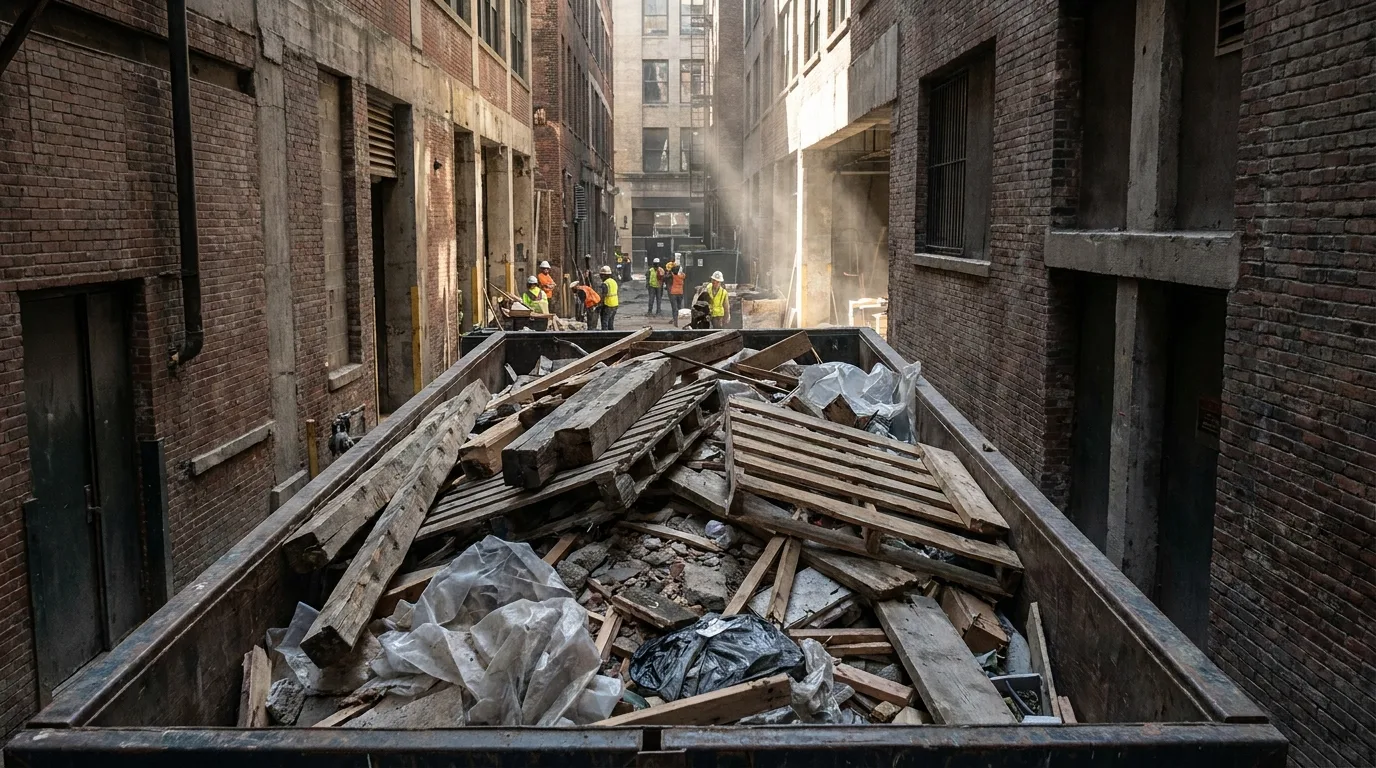
Why are some materials banned from dumpsters?
A roll-off is a municipal waste container, and it is only allowed to carry what a municipal waste landfill or transfer station is permitted to accept. The restrictions are not the hauler being difficult. They are the disposal facility's permit conditions passed back up the chain.
Pennsylvania's operating rules for municipal waste landfills at 25 Pa. Code Section 273.201 spell it out: no bulk or noncontainerized liquid waste, no container holding free liquids larger than one gallon, no lead-acid batteries, and no hazardous waste. If a banned item shows up in a load, the whole load can be rejected at the scale, which turns one wrong item into a second haul you pay for. That is the same reason a 10 yard, a 20 yard, a 30 yard and a 40 yard all carry identical restrictions. Size has nothing to do with it.
What is banned in Pennsylvania specifically?
Three state-level rules cover most of what people try to throw away here.
- Liquids. 25 Pa. Code Section 273.201 keeps bulk liquids out entirely, and containers holding free liquids over a gallon with them. Paint has to be fully dried or solidified first.
- Electronics. The Covered Device Recycling Act, Act 108 of 2010, banned desktop computers, laptops, monitors, televisions, computer peripherals and their components from disposal with municipal waste as of January 24, 2013. Landfills stopped accepting them the same day.
- Lead-acid batteries. Barred by the same landfill regulation. Car and truck batteries go back to a retailer or a scrap yard.
Pennsylvania's Act 101 of 1988, the Municipal Waste Planning, Recycling and Waste Reduction Act, is why haulers file recycling reports at all, and it is the reason a clean separated load is treated differently from mixed debris.
Federal bans that apply on every job
Four more categories, and these apply everywhere.
- Hazardous waste. Anything exhibiting ignitability, corrosivity, reactivity or toxicity under 40 CFR Part 261 is regulated hazardous waste and needs a manifest and a permitted facility.
- Universal waste. Fluorescent tubes, mercury-containing devices, most batteries and pesticides fall under the Universal Waste Rule at 40 CFR Part 273 and go to a collection point.
- Refrigerant appliances. Refrigerators, freezers, window air conditioners, dehumidifiers and water coolers need certified refrigerant recovery under Section 608 of the Clean Air Act before the shell can be scrapped.
- Asbestos. The asbestos NESHAP at 40 CFR Part 61 Subpart M governs handling, and in Philadelphia the Air Management Services Asbestos Control Unit regulates the work under Philadelphia Code Sections 6-606 and 6-607. Notification to the Department is due no less than 24 hours before a project and to EPA 10 working days before a demolition.
The full list, and where each item actually goes
| Material | Why it is out | Where it goes instead |
|---|---|---|
| Paint, solvents, thinners | Liquid waste, 25 Pa. Code 273.201 | Household hazardous waste event, or dry latex out fully first |
| Motor oil, antifreeze, fuel | Liquid and hazardous | Auto parts retailer or licensed collector |
| Car and marine batteries | Lead-acid, banned from landfill | Retailer take-back or scrap yard |
| TVs, monitors, laptops, printers | Act 108 of 2010 | Certified electronics recycler |
| Fridges, freezers, window AC | Clean Air Act Section 608 | Appliance recycler with certified recovery |
| Fluorescent tubes and CFLs | 40 CFR Part 273 | Universal waste collection point |
| Propane tanks and aerosols | Ignitable, 40 CFR Part 261 | Exchange point or hazardous waste event |
| Tires | Separate processing stream | Tire retailer or dedicated hauler |
| Asbestos and asbestos-containing material | 40 CFR 61 Subpart M | Licensed abatement contractor, never a container |
| Medical and infectious waste | Regulated separately | Licensed medical waste handler |
| Railroad ties and treated timber | Creosote and preservatives | Confirm with the facility before loading |
| Contaminated soil | Needs characterisation | Tested and manifested separately |
What can go in, that people assume cannot?
Plenty. General construction and demolition debris, drywall, plaster and lath, framing lumber, roofing shingles, flooring, cabinetry, brick, block, tile, clean concrete, dirt, furniture, carpet and household junk are all normal loads.
Mattresses usually go in with a per-item charge, because most transfer stations pull them for separate processing. Appliances without refrigerant, such as washers, dryers, ranges and dishwashers, are generally fine. Clean masonry and soil are better as a dedicated single-material load than mixed into general debris, because the disposal stream and the price are both different. See construction dumpster rental for how those loads are quoted.
What happens if a banned item ends up in the load?
Best case, the driver spots it at pickup and you pull it out. Worse case, the scale house finds it and the load is rejected, which means the container comes back to your site and you pay for a second haul plus the wasted trip.
Worst case is asbestos or a leaking container, where the disposal facility is obliged to escalate and the site can face enforcement. None of that is worth saving a trip to a drop-off. If you are unsure about one item, ask before it goes in. It takes thirty seconds and we would rather answer it than deal with a rejection at the gate. Run through the pre-delivery checklist before the truck comes, and if the container is going on the street, read the permit rules first.
Where do Philadelphia residents take the banned items?
Residents have a real option. The city runs six Sanitation Convenience Centers, open Monday through Saturday from 8 a.m. to 6 p.m., taking household trash, recycling, bulk items, electronics and yard waste. You have to show proof that you live in Philadelphia, the vehicle has to be under 6,000 pounds total weight, and commercial loads and contractor debris are turned away.
That covers the electronics and the odd appliance. It does not cover a renovation. For a job that produces volume, a container plus a separate trip for the handful of restricted items is the workable answer. Sizes are on the dumpster sizes page and prices on dumpster rental cost.
Common questions
Can I put paint cans in a dumpster?Only if the paint is fully dried out and there is no free liquid. 25 Pa. Code Section 273.201 bars containers holding free liquids over a gallon.
Can I throw away a mattress?Usually yes, with a per-item charge, because it is pulled for separate processing.
Can I put concrete in with regular debris?You can, but it is the fastest way to blow a tonnage allowance. Broken concrete runs about 4,000 pounds per cubic yard. Put it in a 10 yard container as a clean load. See dumpster weight limits.
What about a hot water heater or a boiler?Fine, once drained. Anything with refrigerant is not, under Section 608 of the Clean Air Act.
Does my business need a written waste plan?If you operate regulated premises, yes. Philadelphia Code Sections 10-717 and 10-724 require a Solid Waste and Recycling Plan identifying each hauler you use.
Does a jobsite need anything else?Restrooms, usually. OSHA 1926.51(c)(1) requires one toilet where 20 or fewer workers are on site. See construction site services, portable toilet rental and handwashing requirements.
Start from the roll-off dumpster overview, check the permit rules if it is going on the street, and compare a 20 yard against a 30 yard on volume. Everything we run is on the home page and on porta potty rental in Philadelphia. Send the debris type through the quote form, call the contact page number, or check service areas and the FAQ.
Next step
Get a delivery date
Tell us the address, the dates and the headcount. We size the order and confirm the route.